Monday, November 30, 2009
Followers
I know that two, possibly three people follow this blog. Now you have a chance to announce the fact that you follow this blog. Announcing yourself gives me some idea of who's reading the blog and gives me a chance to target its content at a given audience. See followers gadget in the right margin for details. Click somewhere and see what happens. Haven't tried it myself so I'm not sure how it will work.


Thursday, November 19, 2009
The Dolphin Club

The Dolphin Club in San Francisco is a repository of wooden row boats besides also being a place where members do their swimming in SF Bay. Their row boats are used by members to escort other members who want to swim outside the protection of the cove in front of the club house. The escort system was started after a member was run over by a motor boat back in the sixties. How the club got hold of so many wooden row boats, I don't know, but now that they have them, they need to maintain them. All boats get sanded and re-varnished every five years. Given the number of boats that the club has, they have to do about 5 boats a year.
So every Tuesday night is boat maintenance night. Here are some photos taken this past Tuesday.
 This week's boat all sanded down and ready for varnish.
 The same boat with a new coat of varnish. Four coats to go.
And some more boats, these seating four. Sometimes club members just row. Obviously, these boats are too big to take out just to accompany a single swimmer.
Sunday, November 8, 2009
Spenger's Fresh Fish Grotto

Berkeley has this restaurant called Spenger's Fresh Fish Grotto. I don't know how good their food is, but if you're ever in the area, probably to rub elbows with the area's well-to-do or to spend 15 minutes in line to get coffee at Peet's on fourth street, stop by Spengers to check out their small collection of nautical stuff scattered around the outside of the building.
The most notable item in their collection is a small dugout canoe. I thought for some time that it was local, but am beginning to doubt it. More likely Polynesian. Anyway, here's some pictures of it.

Kinda looks like the fat parts of the hulls are where the amas of the outriggers would have crossed, or is that just where the thwarts went? Don't know much about dugouts.

And yes, believe it or not, the SF bay had a whale processing plant until sometime in the 60's over in Richmond.

And there's a harpoon on one of the last whale boats.
Hokusai's boats

Hokusai has long been my favorite Japanese artist. But for a long time I hadn't looked at his work. Recently, some new Hokusai books were published and I realized that quite a few of Hokusai's wood cuts had boats in them. By western standards, the boats all look curious, square sterned and high bowed. But they do resemble Portuguese surf boats to some extent.

Portuguese had a lot of places where harbors were missing and fishermen had to launch through the surf. As a result, the boats had high bows that would keep the surf from swamping the boats.
Japanese boats apparently had similar conditions to contend with. Makes me want to build some skin on frame small scale surf boats.
.jpg)
The other curious thing about the Japanese boats is the dotted lines along the edges of the planks. Were these boats sewn together like some Polynesian boats?
Friday, November 6, 2009
Oil Spill !!!

NRC dweebes are getting ready to tow a boom out to the oil spill to contain it.
We're having our annual oil spill here in SF bay. Routine stuff by now. "They", whoever they are closed all the beaches and boat ramps facing the bay here in Alameda to allow workers in hazmat suits dab gobs of oil off rocks and the beach with wads of kleenex. Other fine folks are washing oily ducks. Duck death toll so far is 22, not from being washed I presume, but probably from getting oiled.
Meanwhile, boat testing is suspended since I can't get on the water except by launching off the rocks you see in the background of that picture. There is a little beach that I could launch off, except that is closed right now while another set of contractors is cleaning up the radioactive sewer which the navy used to use to run radioactive waste into the bay. Oh well, it's a toxic world we live in.
Reality vs. Fantasy
 to the right, Daniel Everett, the author of Don't Sleep .. or at least his head and its reflection. We cannot be sure if there is more to him than that.
I am in the process of reading a book called Don't Sleep, There Are Snakes. It's an account of how a Christian missionary goes to the Amazon to bring Jesus to an Indian tribe called the Piraha. The Piraha, it turns out, have the unusual trait of only taking their own experience and the first-hand experience of other living humans as evidence of what is real. This amazing trait has made them immune to 300 years of missionary attempts at conversion. In the end, it is the Piraha who convert Everett, the missionary to their view of seeing and not the other way around.
It isn't that the Piraha have a problem with Jesus, it's just that in their world view, they don't care about Jesus because they can't find anyone who has actually seen him or personally heard what he had to say. And it's not that the Piraha pick on Jesus in particular. They wouldn't care any more for the Buddha or Archimedes or Plato or Socrates or any other person long dead.
The Piraha are pragmatists in the extreme or if you will, Missourians of the Amazon. A brief side bar here about the "Show Me State:"
"There are a number of stories and legends behind Missouri's sobriquet "Show-Me" state. The slogan is not official, but is common throughout the state and is used on Missouri license plates.
The most widely known legend attributes the phrase to Missouri's U.S. Congressman Willard Duncan Vandiver, who served in the United States House of Representatives from 1897 to 1903. While a member of the U.S. House Committee on Naval Affairs, Vandiver attended an 1899 naval banquet in Philadelphia. In a speech there, he declared, "I come from a state that raises corn and cotton and cockleburs and Democrats, and frothy eloquence neither convinces nor satisfies me. I am from Missouri. You have got to show me."So what does this have to do with boat building?
Plenty.
In the construction of b0ats, people like to make all sorts of claims based on what they've heard or read or believe.
My response, "Show Me."
In the end, there is no substitute for actually building a boat and trying it out to see what it will do. And what better way is there to quickly build a boat to see what it will do than skin on frame.
Let's hear it for the Piraha and Missouri and skin on frame.
Tuesday, August 4, 2009
Wooden hunting hats at Unangax^ Culture Camp
Patty Gregory Of Unalaska taught wooden hat making at Unangax^ (Aleut) Culture Camp. People were making two kinds of hats, the open crowned visor type and the full crowned type. The full crowned hat was reserved for the more senior hunters. Some kayak models show two holed kayaks where the paddler in front, the more junior of the two wears the visor and the paddler in back, the more senior wears the full crowned hat.

Here's Patty with an arm full of hat blanks and completed visors.
 Mike Livingston and I went down to Poppert's milling in Wasilla to get the wood for the hats. The picture above shows a big piece of cottonwood on the saw bed ready to be sliced into 3/8 inch thick slices. Cottonwood bends well, especially when still wet and green and is therefore a good material for hat blanks.
 Andrew Abyo was at the camp all week working on some full crowned hats. Here he is showing off some of his work, a visor and a mask. For more of his work, go to the Alutiiq museum site.
Here, Andrew is carving away on the blank for a full crowned hat.
 Patty had a picture of Andrew Gronholt set up. Andrew was her hat making teacher.
 Andrew's daughter, right in brown shirt is holding up one of her dad's hats and Patty is showing up a display board of miniature visors.
 Here's the hat again.
 Inside of the hat, showing construction details.
 And a side view, showing the decorations.
 Hat blanks heating up in a tub of boiling water.
 And a visor in the bending jig, drying till the shape sets.
 Andrew is explaining various functional features of the Aleut hunting hat.
 The hat funnels sound. Kids cup their hands to simulate sound amplification of the hat.
 Big pile of shavings left over from a week of hat carving.

Becky Bendixson with here completed full-crown hat.

Here's Patty with an arm full of hat blanks and completed visors.
 Mike Livingston and I went down to Poppert's milling in Wasilla to get the wood for the hats. The picture above shows a big piece of cottonwood on the saw bed ready to be sliced into 3/8 inch thick slices. Cottonwood bends well, especially when still wet and green and is therefore a good material for hat blanks.
  Andrew Abyo was at the camp all week working on some full crowned hats. Here he is showing off some of his work, a visor and a mask. For more of his work, go to the Alutiiq museum site.
Here, Andrew is carving away on the blank for a full crowned hat.
 Patty had a picture of Andrew Gronholt set up. Andrew was her hat making teacher.
 Andrew's daughter, right in brown shirt is holding up one of her dad's hats and Patty is showing up a display board of miniature visors.
 Here's the hat again.
 Inside of the hat, showing construction details.
 And a side view, showing the decorations.
 Hat blanks heating up in a tub of boiling water.
 And a visor in the bending jig, drying till the shape sets.
 Andrew is explaining various functional features of the Aleut hunting hat.
 The hat funnels sound. Kids cup their hands to simulate sound amplification of the hat.
 Big pile of shavings left over from a week of hat carving.
Becky Bendixson with here completed full-crown hat.
Sunday, August 2, 2009
Culture camp how to butcher a seal demo
One of the features of Culture Camp was the preparation of traditional Unangan foods, in this case, a harbor seal. Sally Swetsoff demonstrated how to butcher the seal.
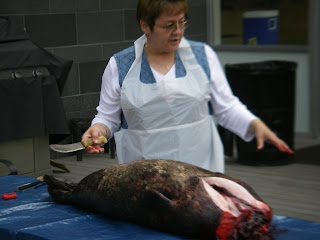 The head is already off. Sally is starting to slice the seal down the middle, belly up.

Here you can see the wind pipe and the layer of white blubber on top of very dark colored flesh.
 The seal is completely opened up revealing the intestines.
 The judgment of some is that this is a smelly process.
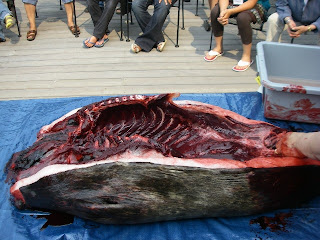 The seal carcass with the intestines removed.

Sally is cutting the connective tissue between coils of intestine. Intestines are later cleaned, braided with strips of blubber, boiled and eaten.
 Sally has removed all the organs and is beginning to cut up the meat.
 Each pied of meat is cut so it has a chunk of blubber with it. The meat by itself is completely fat free and has no marbeling. Hence, fat which is an important nutrient in a cold climate has to be added in.
 The head is already off. Sally is starting to slice the seal down the middle, belly up.
Here you can see the wind pipe and the layer of white blubber on top of very dark colored flesh.
 The seal is completely opened up revealing the intestines.
 The judgment of some is that this is a smelly process.
 The seal carcass with the intestines removed.
Sally is cutting the connective tissue between coils of intestine. Intestines are later cleaned, braided with strips of blubber, boiled and eaten.
 Sally has removed all the organs and is beginning to cut up the meat.
 Each pied of meat is cut so it has a chunk of blubber with it. The meat by itself is completely fat free and has no marbeling. Hence, fat which is an important nutrient in a cold climate has to be added in.
Unangam tunuu
Unangam tunuu is the Aleut name for the Aleut language. According to the Alaskan native institute in Fairbanks there are something like 2000 Aleuts and 300 speakers of the language. That's not a lot of people. Nevertheless, Knut Bergsland of the University of Oslo has written both a dictionary and a grammar of the Aleut language.
While at the APIA culture camp this summer, I had the opportunity to hear Unangam tunuu spoken and have found out how to pronounce some of the specifically Aleut consonants like the x with the hat over it x^. This particular sound is something like the ch sound in German. The APIA has also put out a CD with names of various animals pronounced.
For those interested in the names of Aleut kayak parts, see Knut Bergsland's article in _Contributions to Kayak Studies_.
While at the APIA culture camp this summer, I had the opportunity to hear Unangam tunuu spoken and have found out how to pronounce some of the specifically Aleut consonants like the x with the hat over it x^. This particular sound is something like the ch sound in German. The APIA has also put out a CD with names of various animals pronounced.
For those interested in the names of Aleut kayak parts, see Knut Bergsland's article in _Contributions to Kayak Studies_.
APIA Culture Camp

I recently got back from the apia culture camp held in Anchorage Alaska. APIA stands for Aleut Pribilof Islands Association. The APIA is an Aleut Native non-profit corporation dedicated to education and social services. Mike Livingston and I built two kayaks there. The kayaks will be hanging in the lobby of the APIA building. (see picture above.) Unangam Ulaa means Aleut house or home in Unangam tunuu, the Aleut language. Unangan is the Aleut name for themselves in their language.
 Mike Livingston in front of the culture camp poster.
 Myself in front of the culture camp poster.
Sunday, June 28, 2009
wood, the original carbon fiber composite

Whenever people see me working on a boat with a wooden frame, invariably, somebody comes along and wants to know if the same thing couldn't be done with carbon fiber composite technology. I generally tell them that it could be but I prefer wood and that they should try the carbon fiber composites if they think that those would be a good idea.
However, more recently, I am promoting the idea of wood as the original carbon fiber composite. See above for the molecular structure of graphite. Graphite is all carbon and the molecules are arranged in a hexagonal lattice.
 Wood is made up of cellulose whose chemical arrangement is shown above. Note the hexagonal rings, similar to carbon rings of graphite. The main difference between cellulose and graphite is that cellulose has one oxygen in each ring which makes the ring a little weaker. Also strands of cellulose are held together with lignin, a natural glue. Strands of carbon fiber on the other hand need to be bonded together with epoxy, a man-made glue.
So carbon fiber composites are stronger than wood per unit weight, but not by enough to make me want to put up with the messy construction techniques that they require.
Note to Duane Strosaker - this is not a plastic mocking post. This is a post in defense of wood.
Note to everyone else - see Duane's web page on how to make carbon fiber paddles.
Other Blogs
If you're a native watercraft junkie like me, check out the Indigenous Boats blog by Bob Holtzman. Lots of good stuff there and Bob has tagged it so you can look up postings by topic. What a concept, as Yakov Smirnoff used to say.
Then there's also the 70.8% blog by Thomas Armstrong which is not strictly about native or indigenous boats but has some of that kind of content. Thomas has ads enabled so you get lots of links to boaty books on Amazon.
Then there's also the 70.8% blog by Thomas Armstrong which is not strictly about native or indigenous boats but has some of that kind of content. Thomas has ads enabled so you get lots of links to boaty books on Amazon.
Friday, June 26, 2009
Culture Camps

The Aleut Community in Alaska holds culture camps every year to teach school age kids about their heritage. Various instructors teach different skills like the Unangan language, crafts, dances, cooking and so on.
A few years back I was privileged to attend one of those camps in Cold Bay, Alaska to help with the building of some baidarkas.
The picture above shows Candace, a resident of Cold Bay with one of the baidarkas that the students built. She is also holding a fur seal skin and as the wind was blowing hard, she is hanging on to her hat, another item made in the camp.
This year, I am going back to Alaska to attend another culture camp, this one sponsored by the APIAI, Aleutian Pribilof Islands Association in Anchorage. Pictures to follow.
To see what last year's culture camp was like, read the newsletter of the APIAI.
Cows in Akutan

Somewhere on my webpage I put some pictures of what I call hot spring valley in Akutan, an island in the Aleutians. The Aleutians, you will remember are the place where the Baidarka was invented. Anyway, I put up a picture of myself at the crest of the pass overlooking the valley.

And, barely visible on the valley floors are some cows. The cows were imported by someone wanting to raise them on the one thing that is plentiful in Akutan, grass. That project was eventually abandoned, but the cows stayed behind and have made the hot springs valley their home. I imagine the hot springs keep the grass accessible in the winter and also offer some refuge from the cold. I don't know if the cows hang out in the hot pools up to their necks like those monkeys in Japan, probably not because they have to eat a good part of the day. Still, here they are surviving.
And then yesterday I get an email from a guy named Sam Brown who has just started building skin boats and in the letter, he tells me that it was his family who brought those cows to Akutan. Sam currently lives in Korea and this is where he has been building his skin boats. He also tells me that some of his Korean friends have caught the skinboat bug and want to build some.
So there you have it folks. More evidence that the internet brings people together and brings people together with their cows.
Wednesday, June 24, 2009
Links, links & more links
There's lots of good stuff about boats out there on the internet. And other web authors must surely have links to the relevant pages. But that is not going to stop me from adding yet another list of links. I am going to put this list on my web page and also link to it from this blog. If anyone wants to have their boaty link on this list, let me know and I will add it. Put your suggested links in a comment to this post and I will get email.
Friday, June 19, 2009
pt. hope kayak skeg retrofit

Last year I built a Point Hope kayak. Probably was used as some sort of retrieval kayak. Mostly, Pt. Hope hunters used umiaks to hunt, actually, they still do for the annual whale hunt.
Anyway, I like the boat but it didn't track worth a hoot (pulled that term out of my euphemizer) until after I added a skeg. The skeg worked great on flat water, but it was too much when the wind was blowing cause the nose would go downwind. See above for original configuration.

So I trimmed the skeg down and now the boat handles just fine. A few weeks ago it was blowing 35 mph in the bay with gusts up to 40. I took the pt. hoper out paddling and it did great. It kicked up a little spray, but the upturned nose never dove into any of the short waves, lifted right up and bobbed right along.
I think I paddled into the wind for about 20 minutes and then returned downwind in about 5.
baidarkolounger

A year or so back, I built a King Island kayak and was amazed at how comfortable it was. Beam of the boat was 24 inches, depth at the rear of the cockpit was 15 inches, that is, the distance from the bottom of the keelson to the top of the cockpit rim. Length was about 15 feet. What made the boat so comfortable was the high coaming which made a very comfortable back rest.
So I wanted to make a baidarka that was equally comfortable if not more so and was also capable of some sailing but could still be paddled at a reasonable clip. Of course, as everyone mariner knows if you try to build a boat that is good at more than one thing, you're likely to end up with a boat that is good at none of them.
We'll see.
The design of the boat so far is as follows: Length of gunwales is 16 feet. LOA is about 18 feet. Beam is 32 inches. Depth to sheer at center is about 10 inches.
As the picture above shows, the bottom is pretty flat. I intentionally laid the keel out flat to minimize the amount of vee in the hull. I will be adding an external keel about 1.5 inches deep.
I don't have the sail plan worked out exactly yet, but it will probably look something like the sailplan that Ian Oughtred has designed for his interpretation of a McGregor sailing canoe.

One more thing. The length of the cockpit will be 72 inches. I will be able to lay down in this boat and sleep. Providing of course that I will have some sort of anchor. Hence the name baidarko-lounger.
I have also been reading about sailing canoes. They used to be all the rage about the time that the 19th century turned into the 20th. Then along came paved roads and everyone stopped sailing in canoes in favor of the new fad called bicycling.
Anyway, the sailing canoes used to carry substantial amounts of ballast so they could carry more sail. A 60 pound centerboard made of steel plate was not uncommon. Not only was it heavy, it placed the weight about a foot below the keel of the canoe for maximum effect. Total ballast in these boats was as much as 120 lbs. So I'm going to look into ballast.
More to come.
secondary stability revisited
The other day, I finally figured out what people mean when they talk of secondary stability.
A little bit of background: Go the the internet, that repository of all things worth knowing and you will find an absolute lack of definition for the concept of secondary stability. The truth is that everybody kind of knows what it means but nobody can define it.
Let's back up some more. There is another term used frequently by kayakers and that is primary stability. This term actually has a definition. Primary stability is the slope of a curve at 0 degrees of heel that plots resistance to heeling vs. degrees of heel. In other words, primary stability of a boatis how fast its resistance to heeling increases as you heel it over. The resistance to heeling that the boat offers is also referred to as righting moment and is measured in foot pounds. For conventionally shaped boats like a kayak, righting moment increases with degree of heel, maxes out at some angle and then decreases down to zero at some greater angle. That angle where the righting moment becomes 0 is where the boat capsizes unless corrective measures are applied.
Now back to secondary stability. When kayakers use the term it is usually used as follows. The kayaker has just tried out a new kayak, paddled it, made turns, heeled it over and braced and is now on back on dry land an offers his report on the stability of the kayak. "Primary stability is poor but secondary stability is good." What this statement really says is that although the boat has low primary stability, resistance to heeling increases to some tangible level once the boat is heeled over far enough.
If I had to specify secondary stability in terms that could actually be measured, I would probably do it as a pair of numbers, (maximum righting moment, degree of heel at maximum righting moment.) And there you have it, probably the first non-evasive definition on the internet of secondary stability.
A little bit of background: Go the the internet, that repository of all things worth knowing and you will find an absolute lack of definition for the concept of secondary stability. The truth is that everybody kind of knows what it means but nobody can define it.
Let's back up some more. There is another term used frequently by kayakers and that is primary stability. This term actually has a definition. Primary stability is the slope of a curve at 0 degrees of heel that plots resistance to heeling vs. degrees of heel. In other words, primary stability of a boatis how fast its resistance to heeling increases as you heel it over. The resistance to heeling that the boat offers is also referred to as righting moment and is measured in foot pounds. For conventionally shaped boats like a kayak, righting moment increases with degree of heel, maxes out at some angle and then decreases down to zero at some greater angle. That angle where the righting moment becomes 0 is where the boat capsizes unless corrective measures are applied.
Now back to secondary stability. When kayakers use the term it is usually used as follows. The kayaker has just tried out a new kayak, paddled it, made turns, heeled it over and braced and is now on back on dry land an offers his report on the stability of the kayak. "Primary stability is poor but secondary stability is good." What this statement really says is that although the boat has low primary stability, resistance to heeling increases to some tangible level once the boat is heeled over far enough.
If I had to specify secondary stability in terms that could actually be measured, I would probably do it as a pair of numbers, (maximum righting moment, degree of heel at maximum righting moment.) And there you have it, probably the first non-evasive definition on the internet of secondary stability.
ergonometrics in reverse

Fellow kayaker, Duane Strosaker pointed out to me that I haven't posted since forever. So here goes, more postings.
Today's topic is ergonometrics in reverse.
Ergonometrics is generally defined as using parts of your own body as a yardstick to measure lengths. Before measurements were standardized, everybody used to measure this way.
Ergonometrics in reverse is the measuring of your body with a tape measure to see how it will fit into your kayak.
In the picture above, I am lying on my back on a plank which is balanced on chunk of wood. The point is to slide back and forth on the plank until both the plank and I are balanced. Then I can measure from my feet to the balance point and record the number.
You could also do the same procedure sitting up. This would give you the location of your center of balance when sitting. When you position your own center of balance over the center of buoyancy of your kayak, then in theory, the kayak should trim correctly. The only problem is knowing your kayak's center of buoyancy. If you are a techno weenie and have a naval architecture cad program on your computer and actually know how to use it, then finding center of buoyancy is no problem. Such people do exist. I have seen them posting to kayaking discussion groups.
For the techno deficient among us, we have to proceed by trial and error. Once you have built a boat, you can simply move weight forward and backward in the boat to figure out where the boat trims correctly.
In my case, I already knew where the center of buoyancy of my next baidarka would be. Only problem was that instead of sitting in the kayak, I wanted to be able to recline in it. And that's why I needed my own center of balance or longitudinal center of mass when in the reclined position so I could position the long recliner style cockpit correctly.
I will be posting on the baidarko-lounger soon.
Tuesday, December 16, 2008
New Kayak Fishing Guide


Tony Mullins who built a Greenland kayak with me about 3 years ago has been training his grandson Sean in the kayak paddling arts. Sean in the meantime has graduated to fishing guide duties. Here's Sean in the back guiding his customer and uncle, Patrick. Note that Sean prefers a traditional Aleut paddle for taking the sports out to the prime fishing spots.
 Also in attendance was Sean's cousin Cian in the middle of the boat. Cian is holding the net, ready to land the big ones.
Subscribe to:
Posts (Atom)