Every year, the magazine Scientific American puts out a special issue devoted to a single topic. This year's issue is entitled the end. Or is it?
Popular science magazines aren't noted for their deep thinking. Their editorial content trends firmly toward cheerleading science and technology. So the current issue of Scientific American is a pleasant surprise.
Among other things it has a list of technologies that in the opinion of the editors the world would be better off without. What a concept - technology is not all an unalloyed good! Scientific American is not the first body to have this idea, but for a cheerleading magazine, it is a good start.
It also has an article on resources that the earth does not have limitless supplies of. Among them, oil, silver, gold, copper, coal, all due to run out in this century.
So what does any of this have to do with building skin boats? Nothing, directly, but wood wasn't one of the things we're expected to run out of this century. So skin boat building has some promise for the future. Skinboat building has its problems as well, like what to use for a skin in place of nylon or polyester when the oil is gone later in this century.
Or if you're living in a place that has no wood like Easter Island where you've cut down all your trees, what do you make the frame out of? Problems, problems.
But perhaps the part of skinboat building I like the best, apart from the difficulty of finding a suitable skin is the low tech nature of the process. It isn't reliant on any upstream industries for its raw materials. You can get your own wood, whittle your own dowels and spin your own yarn.
OK, I'm starting to sound like a survivalist. I'm not a survivalist. But I do like whittling my own dowels and thinking about how I would drill holes without electricity and I do own a rip saw, the kind you operate with muscle power. etc. etc.
Well, enough congratulating myself on what a clever fellow I am. Go out and buy a copy of the current Scientific American and read all about the possible ways that the world will end. What the heck disaster sells magazines.
Tuesday, August 31, 2010


Monday, August 23, 2010
Shark Bites
Duane Strosaker, our paddler friend down in Southern California had a run in with a great white shark. Go here for pictures and Duane's account.
Friday, August 20, 2010
Mask Burning Ceremony

The people of Kodiak had a mask burning tradition which like most things native was at one time suppressed in an effort to force the native populations into becoming more like Americans with a European background. However, the people of Kodiak are now trying to reclaim some of their suppressed and lost traditions, the mask burning ceremony among them.

Andrew Abyo, pictured above left with myself at the right invited us, attendees of the Aleut culture camp, to come and view his dance group perform at the mask burning ceremony.

Here is the dance troupe, about half of which is Andrew and his family which would be a key part of the mask burning ceremony.


The man who had made the mask, pictured here in the red shirt, explained to us the background of the ceremony. The ceremony is essentially a memorial service. Details of how the ceremony was practiced in the past are vague. Likewise, information about what the burned masks looked like are scarce since they were burned. But one or two masks survived in museums. Apparently they were incomplete and not used in the ceremony. The mask for this ceremony was based on the ones in the museum.


And now it gets more complicated. In addition to the friends of the dancers there was a group of young people, immigrants into this country who were part of some sort of reality show that the Discovery Channel was doing. The show follows these young people as they travel all over America, trying to find their own identity. The man holding the mask and the woman to the right were both part of the Discovery cast. The woman is handing out goose feathers which people tied to the mask. Each feather represented a prayer or offering that would be released when the mask was burned. While this was going on, two camera crews each composed of a camera man and a sound man zoomed about the area taking pictures of everything that was going on. Surprisingly, the ceremony was powerful enough in its own right that the camera crews didn't detract from it substantially.


Once everyone who wanted to had attached their feather to the mask, one of the dancers donned the mask and the group danced.

When the dance was over, the mask went into the fire.

And here it burns, still recognizable as a face.

And finally, it fell apart.
Thursday, August 12, 2010
Aleut Bent Wood Hat Making

Bent wood hat making at the APIA Culture Camp was once again being taught this year by Patty Lekanoff-Gregory. Bent wood hats come in many different configuration from short visors to long billed visors to full-crowned chief's hats. Patty teaches them all.
 Hats are bent over forms, this one being for a short visor.
 And this one for a large visor or full crowned hat.
Blanks for the hats are cut out on a band saw from poplar stock sawed down to one half inch sheets. The blanks are then carved down in certain places to make them more pliable. Thicker ridges are left in strategic places to make the bent wood take on the proper shape.

Once completed, the blanks are kept wet to maintain their pliability.

When the time comes for bending, the carved blanks are put in boiling water till uniformly hot and then are bent over the bending from. Action at this point is very focused as you can see from the picture. The wood only stays hot and pliable for a short time. If you wait too long and the wood stiffens up, it may crack and hours of work carving go down the drain.

When the bending is complete, the hat is left to dry in its form. When dry, it can be removed from the form and will maintain its shape.

Here Patty and I are showing off the long billed visor she made for me.

My part of the deal was to make Patty a paddle.
Third annual Urban Unangax^ Culture Camp
For the second year in a row, I was invited to participate in the Urban Unangax^ culture camp put on by the APIA, the Aleut Pribilof Islands Association. Recognizing the fact that most Aleuts these days live in urban environments, mainly Anchorage, the APIA has been putting on the culture camp at their new headquarters building in Anchorage. As you might guess from the name, the purpose of the camp is to teach traditional Aleut or Unangan cultural activities to both school age children and adults.
Classes are given in language, basket weaving, regalia, drum making, traditional food preparation, hunting hat construction, kayak construction, dance and more.
A pictorial overview follows.
 Moses Dirks who hails from Atka was this year's instructor in traditional foods. Here he demonstrates how to fillet a salmon in preparation for air drying.

And here are the students following his lead.
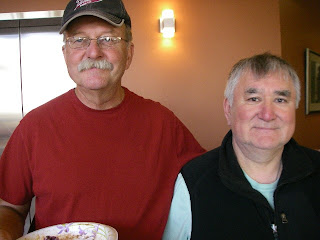 Moses is also one of the few hundred Aleuts who still grew up speaking the Atkan dialect of Unangam Tunuu, the Aleut language. Moses helped with the Aleut pronunciation of kayak parts which Mike Livingston recorded. Moses is on the right and I am on the left with an empty plate heading back into the chow line for seconds.

Which is as good a point as any to introduce the pot luck put on on the last day of culture camp. People bring lots of goodies which anyone would recognize and also Alaskan favorites such as caribou, fish pie, smoked fish, fish soup, etc.
 Aleut women were noted for their fine weaving and basketry which employed specially dried and processed beach grass. Weaving went on inside the building and we were building kayaks outside so I didn't get a chance to take more pictures of the many creations. Next time.
 Kids learned traditional dances which they are putting on here before the big potluck in front of an appreciative audience.

Older kids put on their dance outside on the lawn.

Back when Russia still controlled Alaska, they move some of the Aleuts to the Commander Islands to do the sea otter hunting there. When Russia sold Alaska to the US, the Commander Islands stayed under the control of the Russians. The Russians like the Americans had a policy of modernizing the natives and so, Aleut Culture went into a decline in Russia as it did in the US. Russian Aleuts now are trying to regain their culture and three representatives from Russia were here at the culture camp to see how American Aleuts were teaching traditional culture. In the photo above, two of the Russians on the right and Sally Swetzof one of the American instructors join in on singing a traditional Aleut song.

Younger children, besides learning dances and language also made paper versions of the traditional hunting hats. Each one was also given a traditional Aleut name which was written on a name tag which the photo shows them wearing.

Mask making, a traditional Aleut activity was not taught at the culture camp, but one of the older students improvised with a piece of discarded kayak skin.
 My own participation was in kayak making. This photo shows two baidarkas made by Mike Livingston and myself at last year's camp which now adorn the lobby of the APIA headquarters building.

Future kayak builders were also in attendance. They were skeptical at first but after some persuasion, got into the act.


And I almost forgot the Native Youth Olympics. This year's champion in the high kick was on hand to demonstrate her skill. The object of this sport is to kick a ball suspended above the contestant's head. Due to lag time of my camera, I wasn't able to get it to click the shutter at the critical moment so you have to take my word that she did kick the ball.
Classes are given in language, basket weaving, regalia, drum making, traditional food preparation, hunting hat construction, kayak construction, dance and more.
A pictorial overview follows.
 Moses Dirks who hails from Atka was this year's instructor in traditional foods. Here he demonstrates how to fillet a salmon in preparation for air drying.
And here are the students following his lead.
 Moses is also one of the few hundred Aleuts who still grew up speaking the Atkan dialect of Unangam Tunuu, the Aleut language. Moses helped with the Aleut pronunciation of kayak parts which Mike Livingston recorded. Moses is on the right and I am on the left with an empty plate heading back into the chow line for seconds.
Which is as good a point as any to introduce the pot luck put on on the last day of culture camp. People bring lots of goodies which anyone would recognize and also Alaskan favorites such as caribou, fish pie, smoked fish, fish soup, etc.
 Aleut women were noted for their fine weaving and basketry which employed specially dried and processed beach grass. Weaving went on inside the building and we were building kayaks outside so I didn't get a chance to take more pictures of the many creations. Next time.
 Kids learned traditional dances which they are putting on here before the big potluck in front of an appreciative audience.
Older kids put on their dance outside on the lawn.

Back when Russia still controlled Alaska, they move some of the Aleuts to the Commander Islands to do the sea otter hunting there. When Russia sold Alaska to the US, the Commander Islands stayed under the control of the Russians. The Russians like the Americans had a policy of modernizing the natives and so, Aleut Culture went into a decline in Russia as it did in the US. Russian Aleuts now are trying to regain their culture and three representatives from Russia were here at the culture camp to see how American Aleuts were teaching traditional culture. In the photo above, two of the Russians on the right and Sally Swetzof one of the American instructors join in on singing a traditional Aleut song.

Younger children, besides learning dances and language also made paper versions of the traditional hunting hats. Each one was also given a traditional Aleut name which was written on a name tag which the photo shows them wearing.

Mask making, a traditional Aleut activity was not taught at the culture camp, but one of the older students improvised with a piece of discarded kayak skin.
 My own participation was in kayak making. This photo shows two baidarkas made by Mike Livingston and myself at last year's camp which now adorn the lobby of the APIA headquarters building.
Future kayak builders were also in attendance. They were skeptical at first but after some persuasion, got into the act.


And I almost forgot the Native Youth Olympics. This year's champion in the high kick was on hand to demonstrate her skill. The object of this sport is to kick a ball suspended above the contestant's head. Due to lag time of my camera, I wasn't able to get it to click the shutter at the critical moment so you have to take my word that she did kick the ball.
Monday, July 19, 2010
How did the Aleuts hold their paddles?
Did I already address this issue once before? Maybe. Well, I'm addressing it once again.
The question is, did Aleuts hold their paddles ridge side back or flat side back when paddling? The answer is unclear, at least given the photographic evidence I have. Thanks to a generous sharing of images by Jeff Dickrell of Unalaska, I have a number of vintage photos of Aleut paddlers as evidence. I am presenting these photos here and the answer is that at least in photos, paddlers can be seen holding paddles both ways. What makes the evidence ambiguous are two factors. One is that the photos aren't always clear enough to determine how the paddlers are holding their paddles. The other is that the photos are staged, that is, the paddlers had to maintain their position within camera range and so are possibly paddling backward to keep their kayaks in the frame. As a consequence, they may have reversed the normal paddle orientation.
In any case, and without further ado, I offer up the photos with appropriate commentary.
Keep in mind that blogspot software reduces image size to the point of uselessness for this sort of analysis. So to see the images at a reasonable size, you have to click on them. Here we go.

Here are two guys with their paddles unambiguously facing flat side back. The guy in the back isn't actually holding his paddle, but we can assume that he is resting it the way he paddles it. The guy in the front has an interesting grip on his paddle, that is, with the hands out on the base of the paddle blades and the fingers curled around the blade ridge. Is that how he paddled or is this just a hand position for bracing and positioning the boat for the camera?

Here, both the front and back paddlers are holding their paddles flat side back. The guy in the middle is bracing with an extended paddle stroke putting the paddle in an invisible position.
 This is clearly a posed picture meant to illustrate how the guy in the bow throws a dart while the guy or guys in the back steady the boat. Out of the frame on the left of the lower boat, the bow man is aiming a rifle. The guy in the lower right and the guy in the upper left are both holding their paddles flat side back judging by the curve of the loom. The guy in the left foreground is bracing so it's hard to tell paddle orientation.

In this photo, the guy in the bow is clearly paddling ridge back. The guy in the middle is hard to tell and the guy in the back likewise is hard to tell. Plus he is doing an extended paddle brace where anything seems to go.
 Finally, another picture that doesn't prove anything except that some Aleut paddles had very short looms. A paddler using this kind of paddle would almost be obliged to hold his paddle at the root of the blades like this guy is doing and the most comfortable way to do that would be ridge forward, flat side back.
The question is, did Aleuts hold their paddles ridge side back or flat side back when paddling? The answer is unclear, at least given the photographic evidence I have. Thanks to a generous sharing of images by Jeff Dickrell of Unalaska, I have a number of vintage photos of Aleut paddlers as evidence. I am presenting these photos here and the answer is that at least in photos, paddlers can be seen holding paddles both ways. What makes the evidence ambiguous are two factors. One is that the photos aren't always clear enough to determine how the paddlers are holding their paddles. The other is that the photos are staged, that is, the paddlers had to maintain their position within camera range and so are possibly paddling backward to keep their kayaks in the frame. As a consequence, they may have reversed the normal paddle orientation.
In any case, and without further ado, I offer up the photos with appropriate commentary.
Keep in mind that blogspot software reduces image size to the point of uselessness for this sort of analysis. So to see the images at a reasonable size, you have to click on them. Here we go.

Here are two guys with their paddles unambiguously facing flat side back. The guy in the back isn't actually holding his paddle, but we can assume that he is resting it the way he paddles it. The guy in the front has an interesting grip on his paddle, that is, with the hands out on the base of the paddle blades and the fingers curled around the blade ridge. Is that how he paddled or is this just a hand position for bracing and positioning the boat for the camera?

Here, both the front and back paddlers are holding their paddles flat side back. The guy in the middle is bracing with an extended paddle stroke putting the paddle in an invisible position.
 This is clearly a posed picture meant to illustrate how the guy in the bow throws a dart while the guy or guys in the back steady the boat. Out of the frame on the left of the lower boat, the bow man is aiming a rifle. The guy in the lower right and the guy in the upper left are both holding their paddles flat side back judging by the curve of the loom. The guy in the left foreground is bracing so it's hard to tell paddle orientation.
In this photo, the guy in the bow is clearly paddling ridge back. The guy in the middle is hard to tell and the guy in the back likewise is hard to tell. Plus he is doing an extended paddle brace where anything seems to go.
 Finally, another picture that doesn't prove anything except that some Aleut paddles had very short looms. A paddler using this kind of paddle would almost be obliged to hold his paddle at the root of the blades like this guy is doing and the most comfortable way to do that would be ridge forward, flat side back.
Monday, June 14, 2010
dead man's boat returns to water

Steve Fossett, adventurer
Unlike most of the boats at Nelson's, the Cheyenne actually appeared to have been worked on, mostly on the interior. In any case, I had missed the transition of the Cheyenne from the water to the asphalt at Nelson's and was curious how it had gotten there.
Well, today, Tim Anderson called and let me know that the Cheyenne was going back from the asphalt to the water via big crane and so I drove down to Nelson's to see how big boat transport was done.
Appears that the crane lifts the boat, swings on its axis and deposits the boat in a set of cradles. Then the crane relocates closer to the water, lifts up the boat again and swings it over to the water and lets it down gently. Given the weight of the big boat, the crane needs outriggers to increase its base so it won't flop over on its side when it lifts the boat. So it can't very well drive along with the boat suspended from its boom. Hence the two-hop maneuver.
Anyway, here's some pics.

The Cheyenne after its first hop. The crane has rested it on its cradles. Next step, the crane repositions and then picks the boat up again and drops it in the water.
 The boat's new owner stands under the hull to the left. Apparently, he plans to run charter cruises about the bay with it.
 A view of the hull with rudder and prop. There is one prop on each hull. The prop is for auxiliary power only. The Cheyenne used to have a sail. Word has it that it will now be propelled by a kite designed by Don Montague.
And to make sure that nobody misses the fact that this is a big deal, the owner of the Cheyenne has hired a videographer who records every step of the operation. The whole thing will eventually appear in Imax theaters in 3D. But for now, nothing is going on and the videographer is taking a break.
 The Cheyenne is about to get hoisted up again and the riggers move into position to witness the hoisting.
 The Cheyenne is off her cradles and up in the air and headed for water.
 Orientation of the Cheyenne is controlled by lines attached to each of its four corners.
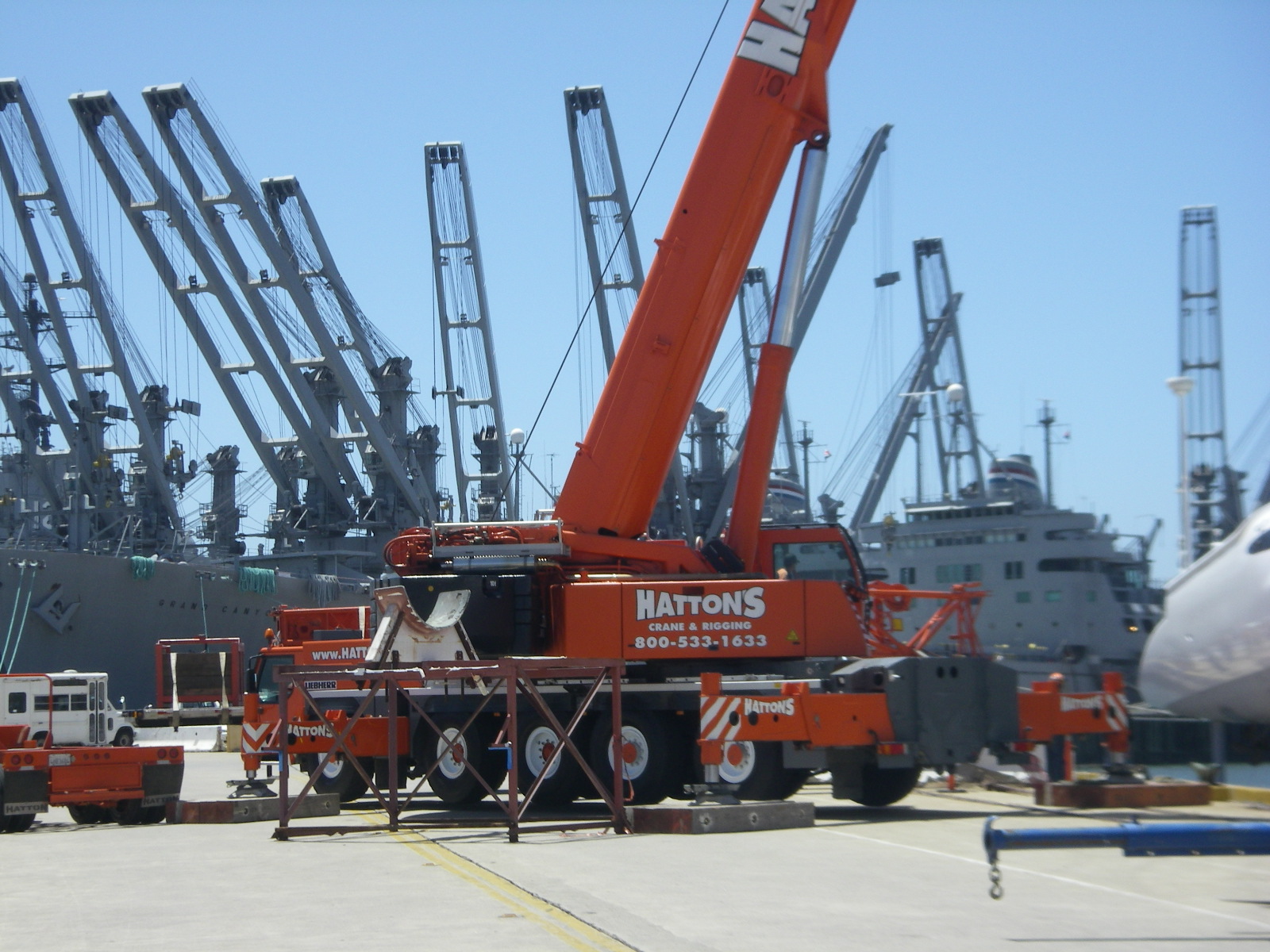 A shot of the crane against a backdrop of the cranes of the reserve fleet. Lots of hoisting potential there.
 And as the Cheyenne is lowered to the water, everyone has to take a picture.
And there she sits in the water. Mission accomplished.
Postscript
I should mention that Steve Fossett held quite a few records in quite a few endeavors, everything from ballooning to round the world sailboat racing. In spite of all the stunts he was involved in, he never killed himself. When he did disappear, it was on a routine flight in a single engine plane. There was quite a bit of searching for his plane with no luck. The search was finally abandoned and he was presumed dead. Some months later, somebody stumbled into the crash site and his body was identified.
I should mention that Steve Fossett held quite a few records in quite a few endeavors, everything from ballooning to round the world sailboat racing. In spite of all the stunts he was involved in, he never killed himself. When he did disappear, it was on a routine flight in a single engine plane. There was quite a bit of searching for his plane with no luck. The search was finally abandoned and he was presumed dead. Some months later, somebody stumbled into the crash site and his body was identified.
Wednesday, June 9, 2010
King Islander

Ken Mannshardt has been building a King Island inspired kayak at my shop. Then the frame was complete, we took some pictures. See below. The hull is less deep and more flat than traditional King Islanders.

Subscribe to:
Posts (Atom)