A while back, an article on kayak models appeared in the journal Qajaq. The gist of the article was that models are not to be trusted since most of them were made for sale in the tourist trade and that craftsmen making boat models for the tourist trade soon learned that making an accurate scale model of a kayak takes way too much time for the money it payed, so they learned to take all sorts of short cuts. I believe the article was written mostly about kayak models built in Greenland. The concluding sentiment of the article was that models were worthless for serious anthropological study.
And the article has some merit. But recently, in looking at models of Unangan kayaks, I am of the opinion that a good deal can be learned from them. The things you can learn from models is probably endless, but let me point out just a few things by way of specific examples. But first, just a few general comments.
The most obvious and recurrent lesson to be learned from kayak models is the overall view. Models show us how the whole thing was put together. We get a picture of the whole ensemble which we seldom have a chance to get in any other way. The way artifacts are collected is usually one item at a time, or a bundle of items without any clues on how they all fit together. Then the museum stores them by category and breaks up all the things that belonged together at one time. Harpoons here, paddles there, hats in a drawer, kayaks on a rack and so on. Everything is split up. Models fortunately allow related items to stay together. Other clues are more statistical and can be informative if we look at a number of models. For instance, what sort of kayak was most common, one hatch, two hatch or three hatch? What sort of hats were kayakers wearing when the models were made? What sort of game were hunters going after based on the implements on deck? And so on.
Not much in the way of a deck load and the paddles have gone awol. But there is a bailing tube on deck. Also, the lower ranking paddler, the one in front is wearing an open crown visor while the paddler in back is wearing a full crown model. And the hair of both paddlers is long and white and both men have beards.
This model is of a three hatch kayak and shows the man in the bow holding a dart and throwing board. This model also shows where the darts were stored, what their relative size was, how they were painted and so on. The paddles are also very nicely carved and appear to be in scale. Just behind the bow paddler is a wooden canteen, an item that I have never seen in a museum but that appears frequently on models.
This batch of hunting implements has gotten separated from its boat, but the museum has fortunately kept the pieces together.
This boat model is a particular favorite of mine. Lots of stuff on deck. The hunters appear to be wearing western head gear. They have a fish on the line and we can see colored trim on both the kayak seams and the seams of their waterproof skin jackets.
And this model gives us a nice view of two paddles with different paint jobs. Again, the paddles seem to be accurately proportioned and carved by someone who also made the full scale version of the various deck paraphernalia.
This blog is about various boat and environment related topics that I care to comment on. First and foremost, this blog is about skin on frame boats, their construction and use, as well as paddle and other stuff related to skin boat use.
Saturday, September 22, 2012
Friday, September 21, 2012
Unangan (Aleut) Kayak Accessories - Sprayskirt and Kamleika
Spray skirts on Unangan kayaks were affixed to the cockpit coaming of
the kayak and stayed with the kayak when it wasn't in use. When the
paddler wanted to take off in his kayak, he stepped into his kayak and sat down and then
pulled up the skirt and threw the strap that held it up over his
shoulder. The top of the skirt had a draw string that the paddler
could tighten to minimize entry of water. According to Jochelson (1925) some kayakers had a way of tying the shoulder strap by means of two rings which allowed the kayaker to quickly disconnect the shoulder strap in case of a capsize.
![]() |
| This model shows the paddler wearing his rain jacket in conjunction with the sprayskirt. |
In the rest of the Bering Sea region, kayakers wear gut skin jackets similar to those of Unangan kayakers. However, in the Bering Sea, skin jackets are fitted with a draw string on the bottom that fits directly over the coaming and eliminates the need for a separate spray skirt. Part of the reason that Unangan kayakers did not use this method may be that their cockpits were relatively small and a jacket fitted to the smaller cockpit would have made the bottom of the jacket too narrow to walk in comfortably.
![]() |
| Paddlers on shore with their kayaks drawn up on the beach. Spray skirts stay attached to the coamings of the kayaks. These kayakers are relatively modern and have adopted Western style hats to replace the bent wood hats and visors that they would have worn in the past. |
![]() |
| If the kayaks were being stored for a little longer time, the sprayskirts could be cinched up at the top and held up with a stick to form a roof over the cockpit opening to keep the rain out. |
Wednesday, September 19, 2012
The Americas Cup
The Americas cup is one of those sailboat races that has been going on for a long time and happens again and again at various intervals. Seeing as it involves large sailboats, only the very rich can compete, albeit with hired crews. This year the race or part of the race is happening in San Francisco Bay on which I live and so the news about it reaches me. I have nothing to offer on the merits of the race but it did happen that the Swedish race team is working out of an aircraft hangar close to my own modest boat shop and so on the way to work or going home from it, I see the boats that compete in the event. So I want to offer some photos of the Swedish boats because I find the boats interesting.
By the way, I understand that the current crop of boats are a short version of what will be in the final competition. And all the boats were built in New Zealand by the same builder to the same specs so that he race is about who has the best crew and not about who has the best boat.
This is one of the two Swedish boats tied off to a buoy in the Seaplane Lagoon. In the background, one of the maintenance hangars from the Naval Air Station days.
The boats and the sails are moved in and out of the water by a crane. They are not that heavy as boats go, around 3000 pounds.
Here is the boat itself, without its rig. Dagger boards are in their retracted position.
And the America's Cup logo and Swedish flag.
The boat has a wing and a jib. The wing is symmetrical about the center plane unlike an airplane wing which is usually flatter on its bottom face.
And there are the Swedes, out on the bay doing their stuff with their support boats motoring behind them.
By the way, I understand that the current crop of boats are a short version of what will be in the final competition. And all the boats were built in New Zealand by the same builder to the same specs so that he race is about who has the best crew and not about who has the best boat.
The boats and the sails are moved in and out of the water by a crane. They are not that heavy as boats go, around 3000 pounds.
Here is the boat itself, without its rig. Dagger boards are in their retracted position.
And the America's Cup logo and Swedish flag.
The boat has a wing and a jib. The wing is symmetrical about the center plane unlike an airplane wing which is usually flatter on its bottom face.
And there are the Swedes, out on the bay doing their stuff with their support boats motoring behind them.
Unangan (Aleut) Kayak Terminology
Unangan kayak terminology has been set down in an article written by Knut Bergsland, Norwegian linguist, now dead, in Contributions to Kayak Studies, Eugene Arima, editor. I think that's the most commas I've ever put in a sentence.
I've been wanting to do an illustrated version of that article for some time, but what has discouraged me is the messy nature of the information in Bergsland's article. The information is messy because there was never just one official way of naming kayak parts in the Aleutians. For one thing, Unangam Tunuu, the Aleut language had multiple dialects, at one time, probably as many dialects as there were tribal groups, something like nine, possibly more. Along came the Russians, consolidated settlements and moved people around and a number of dialects disappeared. The documented dialects remaining were the Eastern Aleut, the Atkan and the Attuan dialects. Then during WWII, the Japanese invaded Attu and moved the Aleut community there to Japan while the US moved the remaining Aleut population to the Alaskan mainland. After WWII, Aleuts were repatriated, Attuans moved to Atka and so the only two dialects that were still alive were the Atkan and the Eastern Aleut.
So when Bergsland collected his list of kayak terminology, he had some historical sources available that documented Attuan terms and speakers of both the Atkan and Eastern Aleut dialects. Not surprisingly, documented Attuan terms are fewer in number than for the other two remaining dialects at the time that Bergsland did his compilation.
And terminology varied over time so that some kayak part may have been called one thing in the 19th century and then something else in the 20th. Keeping all of this straight is not an easy thing.
On top of that, we have to deal with Bergsland's dense and sometimes cryptic writing style. I give one example here.
"On top of the taamx^aax^, on the right side in front of the hatch, there was a hook for holding the paddle when not used, made of wood or baleen, or sometimes ivory (Atka 1952), possibly in the shape of a sea otter (Jochelson 1952:131), called in western EA (1909, 1950) x^aach(a)g^iilux^, in AA (1840, 1952) haachachag^iilux^, derived with the suffixes -g^i- + -alug^- 'place for having -' from the above-mentioned term for paddle, EA (1778-) x^aasi-x, AA Au hassi-x." inhale. and so on he goes. So you rub your eyes, go back to the start of the paragraph, try to match up the English with the Aleut term the two of which are invariably separated by a string of parenthetical phrases and hope you don't miss the period that lets you know that you have finally arrived at the end of the sentence. By the way, the AA, Au and EA sprinkeled liberally around the sentence are abbreviations for the dialects respectively, Atkan Aleut, Attuan Aleut and Eastern Aleut.
You get the idea. I thought it might be nice to have a version of this that puts the Aleut term right with a picture of what it is referring to.
I might put the pictures and words in this blog if I can make that work, the problem being that the blog software controls the size of the pictures, (small) and the layout of the text. Stay tuned.
I've been wanting to do an illustrated version of that article for some time, but what has discouraged me is the messy nature of the information in Bergsland's article. The information is messy because there was never just one official way of naming kayak parts in the Aleutians. For one thing, Unangam Tunuu, the Aleut language had multiple dialects, at one time, probably as many dialects as there were tribal groups, something like nine, possibly more. Along came the Russians, consolidated settlements and moved people around and a number of dialects disappeared. The documented dialects remaining were the Eastern Aleut, the Atkan and the Attuan dialects. Then during WWII, the Japanese invaded Attu and moved the Aleut community there to Japan while the US moved the remaining Aleut population to the Alaskan mainland. After WWII, Aleuts were repatriated, Attuans moved to Atka and so the only two dialects that were still alive were the Atkan and the Eastern Aleut.
So when Bergsland collected his list of kayak terminology, he had some historical sources available that documented Attuan terms and speakers of both the Atkan and Eastern Aleut dialects. Not surprisingly, documented Attuan terms are fewer in number than for the other two remaining dialects at the time that Bergsland did his compilation.
And terminology varied over time so that some kayak part may have been called one thing in the 19th century and then something else in the 20th. Keeping all of this straight is not an easy thing.
On top of that, we have to deal with Bergsland's dense and sometimes cryptic writing style. I give one example here.
"On top of the taamx^aax^, on the right side in front of the hatch, there was a hook for holding the paddle when not used, made of wood or baleen, or sometimes ivory (Atka 1952), possibly in the shape of a sea otter (Jochelson 1952:131), called in western EA (1909, 1950) x^aach(a)g^iilux^, in AA (1840, 1952) haachachag^iilux^, derived with the suffixes -g^i- + -alug^- 'place for having -' from the above-mentioned term for paddle, EA (1778-) x^aasi-x, AA Au hassi-x." inhale. and so on he goes. So you rub your eyes, go back to the start of the paragraph, try to match up the English with the Aleut term the two of which are invariably separated by a string of parenthetical phrases and hope you don't miss the period that lets you know that you have finally arrived at the end of the sentence. By the way, the AA, Au and EA sprinkeled liberally around the sentence are abbreviations for the dialects respectively, Atkan Aleut, Attuan Aleut and Eastern Aleut.
You get the idea. I thought it might be nice to have a version of this that puts the Aleut term right with a picture of what it is referring to.
I might put the pictures and words in this blog if I can make that work, the problem being that the blog software controls the size of the pictures, (small) and the layout of the text. Stay tuned.
Monday, September 17, 2012
Paddle Dynamics
Oh yes, there was also a third paddle, one that was supposed to be a blank for a paddle making class that a prospective student's wife had given him as a Christmas present. Three years or more passed and the student still hadn't managed to arrange a class date to finish the paddle, so I finished it just get the thing out of my shop. And so while I was testing the other two paddles, I thought I would test this one as well.
Things got off to a slow start. The boat I used for a test vehicle belonged to someone else and had very slack deck lines that made it hard to keep spare paddles on deck but after some experimentation, I managed to figure out a way to carry the spare paddles while testing.
Paddle testing for me is usually comparative. Given my testing tools which consist of myself as motor and test evaluator, a gps as speed indicator, a kayak and some suitable body of water to float the boat and offer resistance to forward progress, the tests tend to be subjective and relative. That is, I don't have absolute numbers at the end of the test. I take several paddles, paddle back and forth and compare the performance of the paddles under more or less identical conditions. The two things I can measure are speed and the amount of effort I put into paddling. Effort is hard to measure so it usually means that I try to make the boat go as fast as I can with a given paddle. And when I am going as fast as I can, I measure the speed with the GPS.
Usually what happens is that one paddle feels better than another or one paddle gives me a higher top speed than another. And in general, results tend to be vague impressions more than anything rigidly scientific. But some good can come out of even an unscientific test, as happened in this case.
Let me share my observations.
As expected with the three paddles pictured above, the long paddle gave me the best top speed. This paddle was 98 inches long. The two shorter paddles were both 84 inches long. Normally I like a paddle that is somewhere between 88 and 92 inches long so I expected the 84 inch paddles to be slightly underpowered. As it turned out, they produced top speeds not that much slower than the long paddle. Acceleration with the short paddles was lower than with the long paddle, but by and large, once I got the boat going, the short paddles did pretty well.
What was happening was that the hull speed of the boat was the limiting factor in the test and not the paddles. That is, the short paddles were adequate for getting the boat up to hull speed but couldn't push the boat much beyond that. And that's probably adequate for most situations. The long paddle with its greater blade surface could push the boat beyond its hull speed but at the expense of greater effort.
So the problem with testing paddles using a GPS and a slow boat is that just about any paddle can push the boat up to hull speed and further effort even with a larger paddle produces little extra speed so that measurement of top speed are more an indication of the boat's limitations than any measure of the paddle's effectiveness.
It would be nice to have a meter that could measure the speed of the boat, the resistance offered by the boat and the power needed by the paddler to keep the boat at that speed. If such a thing were available, it would be able to offer a good comparative test of different paddles' effectiveness. Even if two paddles were able to bring a given boat up to the same speed, the one that requires less effort by the paddler would be the better paddle. However, since there is no good way to measure that effort, it is hard to make meaningful claims about the effectiveness of one paddle vs. another and the question of which of two paddles is the better one remains largely subjective.
Sunday, September 16, 2012
Old Boat, Reverse Sheer
I know what you're thinking. That boat was warped on account of that concrete pillar coming out of the cockpit. But not so. The concrete pillar coming out of the cockpit is an accident of framing. I could tell when I was taking the picture that maybe my framing was not that good, but I was not in the mood to reposition the boat just for a picture.
Anyway, what I am trying to show here, and it may be more obvious if you click on the photo to see a larger version of it, is that the sheer line has gone into reverse, that is, the sheer is higher in the middle than at the ends. And the bottom of the boat has flattened out to the point of almost no rocker.
The sheer line for the non-nautical is the line made by the tops of the gunwales, that is, the two boards that form the edge of the deck.
This was not a boat I built, but I am sure that when it was built, it had more sheer and rocker and that the downward movement of the bow and stern with respect to the middle of the boat was the result of the nylon skin tightening up over time.
The other thing I noticed when I build boats is that since both the keelson and the stringers are bent into place over the ribs, they exert a downward force on the ends of the kayak that combined with the force of a shrinking skin will tend to make the keel line of a skin on frame boat more straight over time.
I am theorizing here, but the Unangan (Aleut) builders always built their keelsons in two or three parts and the parts were carved into a curved shape, not bent into place to avoid this kind of downward pressure on the ends of the boat.
Anyway, what I am trying to show here, and it may be more obvious if you click on the photo to see a larger version of it, is that the sheer line has gone into reverse, that is, the sheer is higher in the middle than at the ends. And the bottom of the boat has flattened out to the point of almost no rocker.
The sheer line for the non-nautical is the line made by the tops of the gunwales, that is, the two boards that form the edge of the deck.
This was not a boat I built, but I am sure that when it was built, it had more sheer and rocker and that the downward movement of the bow and stern with respect to the middle of the boat was the result of the nylon skin tightening up over time.
The other thing I noticed when I build boats is that since both the keelson and the stringers are bent into place over the ribs, they exert a downward force on the ends of the kayak that combined with the force of a shrinking skin will tend to make the keel line of a skin on frame boat more straight over time.
I am theorizing here, but the Unangan (Aleut) builders always built their keelsons in two or three parts and the parts were carved into a curved shape, not bent into place to avoid this kind of downward pressure on the ends of the boat.
Labels:
old kayak,
reverse sheer,
three part keelson
Sunday, August 12, 2012
Old Kayak, Bent Ribs & Buckliballs
In my previous post, I described how one of my kayaks spontaneously changed shape in response to a shrinking skin. While this type of response would generally have been regarded as mechanical failure, researchers are now trying to steer this kind of phenomenon to make it perform useful tasks, that is by creating a variable shape that can adapt to conditions.
Paraphrasing here - One stress makes you larger, one stress makes you small, and the stress that mother gives you don't do anything at all. Never mind. Pause for groans to subside.
By the way, if you didn't grow up in the sixties, which is likely, you probably missed Buckminster Fuller and his geodesic domes and also buckyballs which he invented and which I suppose buckliballs is a pun on.
![]() |
| Buckliball changing from large to small (left to right) in response to external stress |
Paraphrasing here - One stress makes you larger, one stress makes you small, and the stress that mother gives you don't do anything at all. Never mind. Pause for groans to subside.
![]() |
| geodesic dome assembly |
Labels:
bent ribs,
buckliball,
buckyball,
skin on frame kayak
Friday, August 10, 2012
Old Kayak, Bent Ribs
I've got one more set of photos on deck for the old kayak series. Not that I don't have more old kayaks or old kayak photos, but it's a matter of being able to find them.
Today's tale of woe is all about the lethal combination of heavy nylon fabric and a boat left out in the sun for too long. Nylon, if you don't already know, contracts with high temps and as you can see in the photos, pushes down on the keelson and bends the ribs into a reverse curve. This isn't that bad, mostly it makes the hull a little flatter. What is worse is the end to end shrinkage of the fabric which compresses the keelson which responds by taking on something of an S curve when viewed from above. This makes the boat pull to one side. But even that is not lethal and I managed to fix it with a rudder. It's just that the boat is not the elegant craft that you started out with. So beware of heavy nylon combined with heavy sun.
Labels:
baidarka,
old kayak,
recurved ribs,
skin on frame kayak
Thursday, August 9, 2012
Old Kayak, Old Paint, Part 2
For the premise of this post, go back one post. This post is about yet another instance of a paint job gone wrong. Not functionally wrong, just esthetically wrong, though not entirely, not in my estimation anyway.
I took these pictures just before repainting the hull of my favorite Unangan kayak, (baidarka). The reason I was repainting was not that the finish looked spotty. I actually liked the look, sort of organic, but rather that there was wear in the base coat that was letting water leak in.
The original sealer on this boat was varnish which gives the boat a vaguely rawhide colored look. But I wanted something darker like rawhide that's sat in a museum for 200 years. I was able to achieve that look, or so I thought until I questioned other people what it looked like and they said it looked like tree bark. What I had done was mix oil color with varnish and I painted that over the original varnish coat.
If I had read the label on the varnish I would have found out that once the varnish is fully cured, you need to sand it before you try to paint over it. As you might guess, I just painted without sanding and so after about a year or so the new paint turned brittle and on exposure to sun started flaking off a little at a time. As I said, I liked the look - kind of like lichen on a rock or a seal with the mange, but I finally had to throw in the towel on this paint job and scraped and sanded and then covered it over with a coat of gray latex paint.
I took these pictures just before repainting the hull of my favorite Unangan kayak, (baidarka). The reason I was repainting was not that the finish looked spotty. I actually liked the look, sort of organic, but rather that there was wear in the base coat that was letting water leak in.
The original sealer on this boat was varnish which gives the boat a vaguely rawhide colored look. But I wanted something darker like rawhide that's sat in a museum for 200 years. I was able to achieve that look, or so I thought until I questioned other people what it looked like and they said it looked like tree bark. What I had done was mix oil color with varnish and I painted that over the original varnish coat.
If I had read the label on the varnish I would have found out that once the varnish is fully cured, you need to sand it before you try to paint over it. As you might guess, I just painted without sanding and so after about a year or so the new paint turned brittle and on exposure to sun started flaking off a little at a time. As I said, I liked the look - kind of like lichen on a rock or a seal with the mange, but I finally had to throw in the towel on this paint job and scraped and sanded and then covered it over with a coat of gray latex paint.
This Old Kayak, Old Paint, Part 1
People occasionally write me to ask whether they can use this or that material or process in the building of their boat. I sometimes have answers for them and more often do not. When I don't, I like to tell them to try whatever it is they are asking about and they will find out if it works or not and then they will be the experts on that particular topic.
In any case, I try a lot of stuff, more or less indifferent that a lot of it won't work. I also am casual about boat storage so most of my boats are subject to accelerated aging. I also like to use off the shelf, not yacht approved materials to see whether there is a cheap way out of any particular conundrum.
So let's move on to today's topic, Old Paint. No not the horse. Old paint that has turned dry and brittle and stressed and developed cracks. To be more specific, old varnish. Because the substrate of the varnish on a skin on frame boat is a flexible fabric, impact on the skin causes fractures in an interesting way. So proceed and feast your eyes on a variety of stress cracks in old varnish on a nylon skin. Enjoy.
In any case, I try a lot of stuff, more or less indifferent that a lot of it won't work. I also am casual about boat storage so most of my boats are subject to accelerated aging. I also like to use off the shelf, not yacht approved materials to see whether there is a cheap way out of any particular conundrum.
So let's move on to today's topic, Old Paint. No not the horse. Old paint that has turned dry and brittle and stressed and developed cracks. To be more specific, old varnish. Because the substrate of the varnish on a skin on frame boat is a flexible fabric, impact on the skin causes fractures in an interesting way. So proceed and feast your eyes on a variety of stress cracks in old varnish on a nylon skin. Enjoy.
![]() |
| A small running critter. The green flecks are fake gold leaf I put in the varnish. The gold is actually brass and has oxidized to a green. |
![]() |
| stretch marks. |
![]() |
| Southwestern US petroglyph, what of, I'm not sure. |
![]() |
| and a braid. |
![]() |
| More stretch marks. |
![]() |
| This one kind of looks like an ancient shrimp fossil. |
![]() |
| This one, I'm not sure, kind of like a cartoon bird in flight. |
Yup'ik Science
If you have $45 to spare you might want to pick up a book called The Way We Genuinely Live: Masterworks of Yup'ik Science and Survival. The book is of the coffee table genre and lavishly illustrated with color photos. The book reflects a fairly recent trend of including native commentary on native objects, in this case, Yup'ik artifacts in the collection of the Ethnologisches Museum Berlin.
It is the commentary by several Yup'ik elders who traveled to the museum that makes the book especially worthwhile. It is their stories and reminiscense that makes the objects come alive.
One of the things that struck me in reading this book is that no comparable book exists for the Aleut culture. I wonder of course why this might be and my theory is that the Yup'ik culture was not colonized and consequently changed much until recently. The Aleut region by comparison was discovered by Russians in 1741 and quickly colonized thereafter. Colonization for the Aleuts meant first of all a decline in population of some 90% within 50 years of Russian arrival. This meant that there was a much smaller population to carry on the culture. Secondly, the surviving members of the culture were pressed into service by the Russians and integrated or subjugated to their economy. This meant that traditional ways of making a living were severely impacted.
I don't know much about the history of the Yup'ik region but I suspect the decline of their traditional culture came much later because they had nothing much that European Americans were interested in, and as a consequence were mostly left alone. It was the sea otter and the fur seal that interested the Russians and apparently the Yup'ik were lacking in these and so concentrated on the Aleutian region instead.
In any case, it is fortunate that Ann Fienup Riordan has organized this book and recorded the fascinating history of Yup'ik artifacts.
The book is a welcome departure from the usual catalogs of Arctic artifacts that do little more than name the objects illustrated and the place where they were collected and leave us to guess how they were used.
Sunday, July 29, 2012
Why not King Island?
After I built my first King Island style kayak a few years ago, I realized that it had quite a few good features and would no doubt be a good boat for kayak replicators to build. However, the boat did not have any kind of reputation and people weren't building too many of the King Island or for that matter, any other of the Bering sea kayaks. I was going to write something about this at the time but didn't. Then I got a call from Dave Wilhelm who makes King Island kayaks and we talked about how this kayak type is under-appreciated. You can read about Dave's appraisal of the virtues of this kayak by following the link. Meanwhile, I will give you my theory of why some kayaks are more appreciated than others.
The reason is really quite simple. The Unangan kayak, or baidarka has a larger following than most of the Bering Sea kayaks because George Dyson's book, Baidarka did a lot to propagandize it. George provides a lot of quotes from explorers who when first encountering these kayaks were impressed by their excellent performance.
Nobody has done this kind of promotion for the other kinds of Alaskan kayaks. David Zimmerly published the book Qajaq which shows plans for a number of Alaskan kayaks and he also did a book on the Hooper Bay kayak but unlike George Dyson, Zimmerly never did the kind of sales job that George Dyson did. And so, these boats remain underappreciated.
But some of the lack of Bering Sea kayak replication is also practical. Bering Sea kayaks are large volume kayaks made for carrying up to 900 pounds of gear. Most recreational kayakers do not need this kind of cargo capacity and the extra volume makes for a slower boat than one built to be paddled empty. Of course, the Bering Sea designs can be scaled down for recreational use, something that few people have done although Dave Wilhelm has moved in that direction and Skip Snaith and Sean Gallagher have as well and their efforts will no doubt popularize the type and put more of them out on the water.
The reason is really quite simple. The Unangan kayak, or baidarka has a larger following than most of the Bering Sea kayaks because George Dyson's book, Baidarka did a lot to propagandize it. George provides a lot of quotes from explorers who when first encountering these kayaks were impressed by their excellent performance.
Nobody has done this kind of promotion for the other kinds of Alaskan kayaks. David Zimmerly published the book Qajaq which shows plans for a number of Alaskan kayaks and he also did a book on the Hooper Bay kayak but unlike George Dyson, Zimmerly never did the kind of sales job that George Dyson did. And so, these boats remain underappreciated.
But some of the lack of Bering Sea kayak replication is also practical. Bering Sea kayaks are large volume kayaks made for carrying up to 900 pounds of gear. Most recreational kayakers do not need this kind of cargo capacity and the extra volume makes for a slower boat than one built to be paddled empty. Of course, the Bering Sea designs can be scaled down for recreational use, something that few people have done although Dave Wilhelm has moved in that direction and Skip Snaith and Sean Gallagher have as well and their efforts will no doubt popularize the type and put more of them out on the water.
Kayak Seats
While looking for something which I did not end up finding, I ran across these pictures taken several years ago at SSTIKS, the South Sound Traditional Inuit Kayak Symposium which takes place every year in the vicinity of Tacoma, Washington. It's time to dust off these pictures and share them with the world.
(Side note 1 - Dusting off is a metaphorical term from the age of printed photos. Since these photos have never left their digital format, the dust they may have gathered is strictly figurative. Digital of course is forever or at least as long as the storage medium lasts and as long as you have some display technology and so they do not gather dust, not even figurative dust. In real life, they just seem to disappear never to be found again.)
I have no particular agenda to this posting other than pointing out that when you make your own stuff, you get to have it your way, within the limits of your ability, of course.
This is a molded seat which you can just stick into your kayak or if ambitious, you can glue it in place with contact cement. Note the coaming attachment. (side note 2 - the white stuff on the ground is oyster shells, hard on bare feet.)
This boat may be one of the Tom Yost model kayaks. Coaming rim looks to be plywood. Back rest is a block of foam and the seat cushion is of uncertain origin, possibly foam inside a cloth sleeve or maybe one of those inflatable seats.
Here's another back strap version, adjustable, possibly home made. Seating is foam pads.
Yet another foam solution. The seating mat seams to have a sculpted seat under it.
The frame of this boat is made out of bamboo and the mouth has a fanciful dragon design painted on it.
Cushions of the dragon boat have a tie dye fabric cover on them. Note the hull stringers of bamboo. If you click on this photo, you can see the innovative joining of stringer parts with the skinny end of the tapering bamboo pole overlapping.
And yet another seat cushion. This one looks like the level of complexity that I usually aspire to. One reason my boats have no fancy seats is that it never occurred to me to put fancy seats in my kayaks since a simple mat on the floor seems to work. However, if you come to DIY kayaks from the commercial realm, you are more likely to feel like you should put a fancy seat in your boat like the commercial kayaks have.
One last seat. Looks like commercial back band with foam seat.
(Side note 1 - Dusting off is a metaphorical term from the age of printed photos. Since these photos have never left their digital format, the dust they may have gathered is strictly figurative. Digital of course is forever or at least as long as the storage medium lasts and as long as you have some display technology and so they do not gather dust, not even figurative dust. In real life, they just seem to disappear never to be found again.)
I have no particular agenda to this posting other than pointing out that when you make your own stuff, you get to have it your way, within the limits of your ability, of course.
This is a molded seat which you can just stick into your kayak or if ambitious, you can glue it in place with contact cement. Note the coaming attachment. (side note 2 - the white stuff on the ground is oyster shells, hard on bare feet.)
This boat may be one of the Tom Yost model kayaks. Coaming rim looks to be plywood. Back rest is a block of foam and the seat cushion is of uncertain origin, possibly foam inside a cloth sleeve or maybe one of those inflatable seats.
Here's another back strap version, adjustable, possibly home made. Seating is foam pads.
Yet another foam solution. The seating mat seams to have a sculpted seat under it.
The frame of this boat is made out of bamboo and the mouth has a fanciful dragon design painted on it.
Cushions of the dragon boat have a tie dye fabric cover on them. Note the hull stringers of bamboo. If you click on this photo, you can see the innovative joining of stringer parts with the skinny end of the tapering bamboo pole overlapping.
And yet another seat cushion. This one looks like the level of complexity that I usually aspire to. One reason my boats have no fancy seats is that it never occurred to me to put fancy seats in my kayaks since a simple mat on the floor seems to work. However, if you come to DIY kayaks from the commercial realm, you are more likely to feel like you should put a fancy seat in your boat like the commercial kayaks have.
One last seat. Looks like commercial back band with foam seat.
Wednesday, July 18, 2012
Kayak Stability
Yesterday I had a prospective boat building student try out some kayaks so he could see what would be suitable for him. Turned out he wanted a small boat that was light weight and stable. Also turned out that his idea of stable was much different than mine. Also had a light come on in my head that illuminated the part of the stability equation that connects stability with boat weight. The long and the short of it is that aside from form making a boat stable, weight also does, especially for a small boat where the weight of the passenger can easily exceed that of the boat.
So my prospective student was essentially asking for two conflicting characteristics in a kayak, light weight and stability. Furthermore, he illuminated once again what I already knew but need to be reminded of periodically that operating a small boat takes some minimum of physical dexterity and strength. And my prospective student was below the bar on both counts for traditional kayaks. I could have put him in my sixty pound plus baidarka lounger boat and he would probably have been fine, but he kept telling me that he wanted a light boat.
So as you might expect, the deal fell through. No sale on the building of the boat. Still, I learned something. I know I could have had him build a boat that was sufficiently stable even for his needs but his fear of the boats I did have available was greater than any promises of what I could do for him.
So my prospective student was essentially asking for two conflicting characteristics in a kayak, light weight and stability. Furthermore, he illuminated once again what I already knew but need to be reminded of periodically that operating a small boat takes some minimum of physical dexterity and strength. And my prospective student was below the bar on both counts for traditional kayaks. I could have put him in my sixty pound plus baidarka lounger boat and he would probably have been fine, but he kept telling me that he wanted a light boat.
So as you might expect, the deal fell through. No sale on the building of the boat. Still, I learned something. I know I could have had him build a boat that was sufficiently stable even for his needs but his fear of the boats I did have available was greater than any promises of what I could do for him.
Sunday, July 1, 2012
Urban Unangax^ Culture Camp
Day 9, Saturday
Culture camp is over. All that's left is the closing ceremonies and celebrations.
One last session with the lion.
And another one.
It's another sunny day.
They finished slapping new siding on the back of the motel. Soon the whole place will look like this.
We have some time so we head downtown to the sun city cafe for breakfast. Turns out there's a one hour wait. We head back and go to the Village Inn cafe where you can get coffee within 3 minutes and breakfast within 15.
Before we leave downtown we stop by to admire the statue of Captain Cook whom the Cook Inlet is named after.
Then we load up some kayaks and head off to the Alaska Native Heritage Center. On the way, we pass the Parkwood Inn where we stayed last year. The place was pretty shabby and we referred to it as the Crackwood Inn.
At the heritage center we are having a potluck lunch in the Athabaskan ceremonial hall.
But first the blessing of the food.
I put some of this on my plate, not knowing what it was, maybe some jello product with blood in it. Turns out it was mucktuck. The pink stuff is fat. The black stuff is skin, all from a whale. Tasted pretty good though a bit chewy.
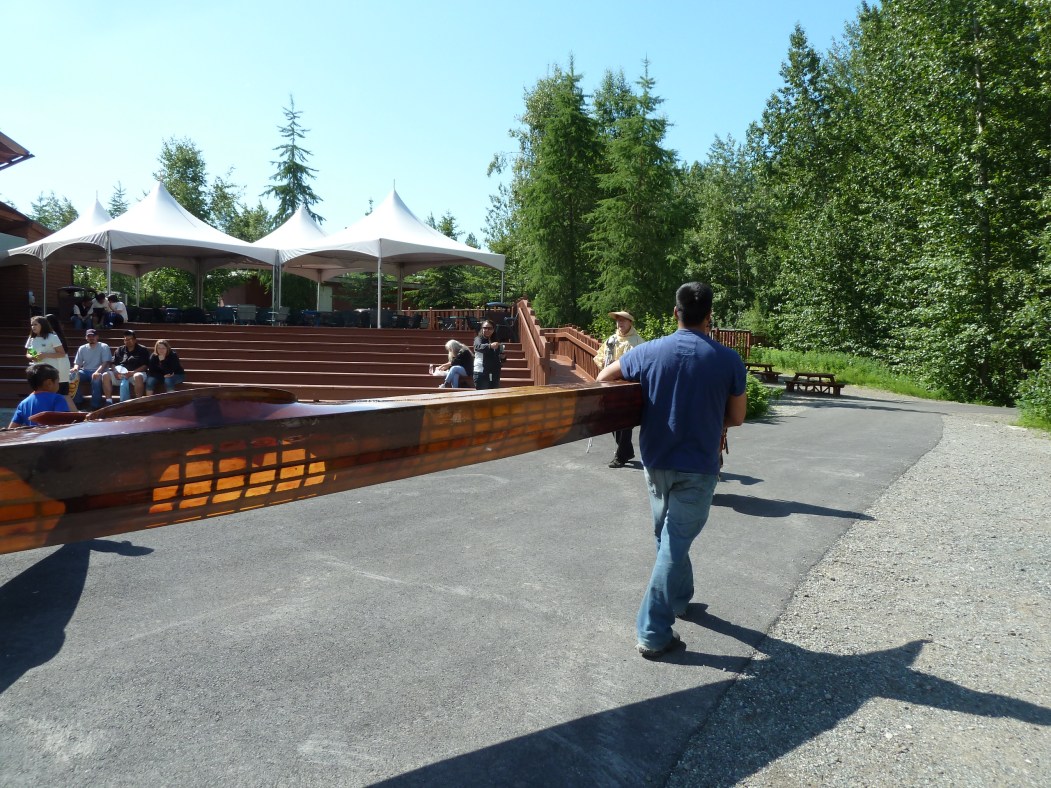
Then we carried kayaks we made in the past up to the pond.
The Orthodox father blessed the boats.
And then, everyone who wanted to got a shot at paddling the kayaks.
I think this could be a picture of a bald eagle. There were some ducks in the pond and the eagle was dive bombing the ducks, but without catching any.
Mitch Poling, boat builder from pt. Townsend and his wife Sandra.
Mitch was building two three hatch Sugpiac kayaks with the help of a number of assistants.
This place was near our motel. We passed it every day on the way to the apia though we never went in. Still haven't.
And a final shot of the rug. No more empty food boxes. We think our fast food neighbor had moved out.
Culture camp is over. All that's left is the closing ceremonies and celebrations.
One last session with the lion.
And another one.
It's another sunny day.
They finished slapping new siding on the back of the motel. Soon the whole place will look like this.
We have some time so we head downtown to the sun city cafe for breakfast. Turns out there's a one hour wait. We head back and go to the Village Inn cafe where you can get coffee within 3 minutes and breakfast within 15.
Before we leave downtown we stop by to admire the statue of Captain Cook whom the Cook Inlet is named after.
Then we load up some kayaks and head off to the Alaska Native Heritage Center. On the way, we pass the Parkwood Inn where we stayed last year. The place was pretty shabby and we referred to it as the Crackwood Inn.
At the heritage center we are having a potluck lunch in the Athabaskan ceremonial hall.
But first the blessing of the food.
I put some of this on my plate, not knowing what it was, maybe some jello product with blood in it. Turns out it was mucktuck. The pink stuff is fat. The black stuff is skin, all from a whale. Tasted pretty good though a bit chewy.
Then we carried kayaks we made in the past up to the pond.
The Orthodox father blessed the boats.
And then, everyone who wanted to got a shot at paddling the kayaks.
I think this could be a picture of a bald eagle. There were some ducks in the pond and the eagle was dive bombing the ducks, but without catching any.
Mitch Poling, boat builder from pt. Townsend and his wife Sandra.
Mitch was building two three hatch Sugpiac kayaks with the help of a number of assistants.
This place was near our motel. We passed it every day on the way to the apia though we never went in. Still haven't.
And a final shot of the rug. No more empty food boxes. We think our fast food neighbor had moved out.
Subscribe to:
Posts (Atom)