Sunday, April 28, 2013

l'hydroptere in Alameda

The French boat l'hydroptere is currently in Alameda being overhauled at Nelson Marine before heading to LA where the team will try to beat the world record time for the LA to Honolulu trip.  Apparently, the boat did over 45 knots in San Francisco Bay. If this sort of thing interests you, you can find full details at the l'hydroptere website.
If you go to the website, note that everyone is wearing wetsuits.  Because these boats are fast they make for lots of spray.  Sailing these boats is apparently more of an athletic event than a pleasure ride.
Here it is. The boat has a main hull and two outriggers.  The foils extend down from the outriggers.

A closeup of one of the foils, folded up from the outrigger.

And another view of one of the outriggers detached from the wing.  You can also see the steering wheel of which there are two, one on each wing.

Five Gyres and More


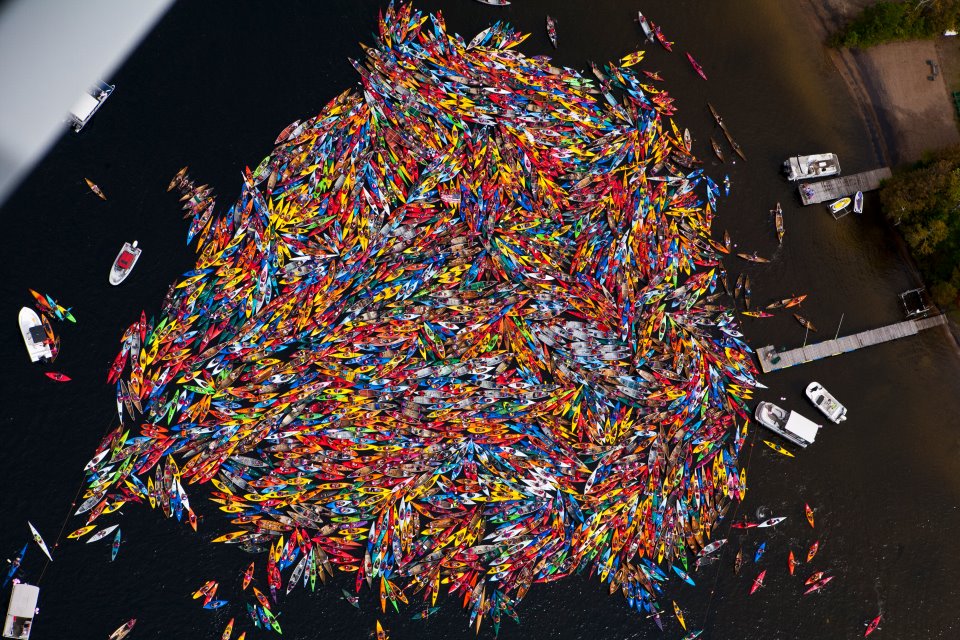
 I saw this photo of kayakers on facebook and the thing that popped into my head unbidden was, Plastic Gyre.  Of course this isn't a plastic gyre, the real plasic gyres are in the world's oceans and there are five of them and they are huge, and while there may be some plastic kayaks or kayak parts in these gyres, the majority of the plastic is from other sources.  So whenever kayakers decry plastic pollution, I see some irony in their stance.
I posted this picture before under the heading, how many kayaks are there? and this massive assembly of kayaks really does come close to being a genuine plastic gyre. And before you accuse me of being holier than thou with my wood frame skin on frame kayaks, I confess that yes,  there are plastic resins used in its construction, mostly in the skin and the lashings and the coatings used to seal the skin.  And I also wear some plastic garments when paddling and the small fibers that they're composed of break off during washing and end up in the ocean where they displace plankton in the bodies of animals that eat plankton.
Let's let the issue of whether I am a hypocrite or not rest for a moment and look at the obvious problem of plastic pollution in the world's oceans.  The organization Five Gyres has devoted itself to the problem. Click on THIS LINK to find out more about them.
Policy director Stiv Wilson of Five Gyres explains in an ARTICLE that plastic pollution on the world's beaches is not the main problem but could be a big part of the solution. While the five gyres collect plastic that has made it into the oceans, they also spit out a certain percentage of plastic each year.  Some of the plastic moves on to different gyres, but some of it also gets spit out and ends up on beaches.
If we were to stop making plastics tomorrow, and did annual beach cleanups, plastic would be gone from the world's oceans in a matter of decades.
The problem with the plastic in the oceans is not that the plastic ends up on our beaches and assaults our esthetics but rather that when in the ocean it harms the animals that live there. Inundating the world in plastic products and then expecting none of them to end up in the oceans is not realistic.  Maybe stopping the production of plastic is not realistic either but it sure would fix the problem.  What we have to decide is whether not having plastics in our lives is a bigger inconvenience than having it in our oceans. We've lived without plastics before and we can do it again.

Wednesday, April 24, 2013

Sausalito, Houseboats and Rowboats

A woman who will be building a kayak with me gave me a tour of her housboat community in Sausalito.  I took some photos of the houseboats and a few of the rowboats docked near the houseboats.  The nice thing about a rowboat next to a houseboat is that in the morning you can get some exercise without going to the gym.
Not much to comment about here other than that the houseboat community seems to have arisen sometime in the 60's.  Some notable folks have lived on housboats in Sausalito, among them, Alan Watts, a popularizer of Asian religions and more recently, Steward Brand, publisher of the Whole Earth Catalog.  All these names used to be household words back in the seventies.  More recent arrivals to this world may have to google them.  So without further ado, photos of houseboats --
One more thing.  I should mention that there are several groupings of houseboats in Sausalito and this is just one of them.


Some housboats are boats.  This one used to be the Mare Island ferry.
Some houseboats like this one have floats.
The quonset hut.

And this one would be at home in town with a lawn out front.

And this one looks like a tugboat expansion

And some rowboats

This is a model that students build in a class.  Each student gets to take home their model.  And all students also work on the full size boat pictured below.  I assume they get a ride in it when it's done.


This pram was just sitting there at a boatshop.
 

The boats above are famous designs whose names I was told but promptly forgot. But to my credit, I recognized the names. You would probably as well.
This one just looked bright and cheerful.
And one more cheerful set and then we have to go.

Thursday, March 28, 2013

Eating Mesquite

The mesquite is a small leguminous tree that grows throughout the American Southwest.  It blooms early in the year and then, late in the year, it grows long beans that eventually drop to the ground.  Unlike the beans we typically eat, these beans stay in their pod which does not dry out and release the beans but stays whole and keeps the beans locked inside.
 Mesquite beans on the ground under the mesquite tree.  In no time at all, you can collect enough for a meal. I did collect a bunch but made no attempt to eat them until I got home.
 The collection site right behind our breakfast table.  The picture was taken in January and all the beans were on the ground.

 Back home, I tossed a bunch of the beans in a high power blender.
The ground up beans looked like this.  I sifted them through a colander.

The sifted meal looked like this.  The meal is a combination of the ground up hull and the insides of the beans.

 The shell of the bean itself resists grinding and gets tossed.
Animals on the other hand eat the whole thing, hull and bean, possibly doing some chewing and run it through their digestive tract and deposit the hulls on the ground.
The next step is to do something with the meal.  You can get recipes online or you can just improvise.  The mesquite meal is sweet with just a hint of sour.  You can make a rue with it and add it to soup or parch it in a pan and use it as a thickener for stews as you would any flour.  Unlike flower, it does have a distinctive taste, however which you may or may not like, mostly it is a little sour and sweet and you may need to experiment until you find where to put it into your food regimen.

The Problem with Food


Recently, a friend gave me a few packages of fresh herring.  Herring were running in San Francisco Bay and he had caught and frozen about 150 pounds.  He urged me to give away as much herring as I could and to come back for more if I was successful.  Seemed like a good deal.  Just a few days earlier I had paid $5 a pound for herring at a fish market.  I also found out that herring wholesaled for $0.50 a pound.  That's a ten fold markup from wholesale to retail.  So here was a heck of a good deal, free herring that you would have to pay $5 a pound for at the store.
I got on the phone and called some Swedish friends who I was sure would want some herring because Swedes live by the sea and are fond of eating fish, or so I thought.  Turned out my friends were not that kind of Swedes.  They told me that they didn't care for cleaning fish.  But they would ask some other friends of theirs if they wanted some of the herring.  A little later they called back and said that they would take ten herring.  I told them that they were all frozen together in a package and the smallest quantity I could give them was 20.  Reluctantly they agreed to take one package.
So much for giving away food.
I suspect the problem with food is that we have gotten used to getting it in meal sized portions, all prepared and wrapped in plastic along with instructions for how to cook it.
The average consumer with a job who can afford to buy food seems to work until very late in the day and when he or she comes home is in no mood to deal with something that needs to be cleaned, possibly filleted and then cooked, especially if they have no clue on how to clean, fillet and cook something as exotic as a herring.  Much better to pull something out of the freezer and pop it in the microwave for 2 minutes. Like breaded fish sticks with no bones in them or pictures of dead dolphins on the package or anything unpleasant.
Another problem with food, particularly at the production end is that it doesn't come off some just in time supply chain.  It tends to for the most part be the result of some natural process that delivers a particular food in great quantities more or less all at once.  Most of the year there are no herring or cherries or sweet corn or peaches and then for a short time, there are more than you can eat unless you do something unpleasant and time-consuming like canning or otherwise preparing and freezing or salting and smoking your own food.  And who that spends ten to twelve hours in a cubicle or behind the counter of a convenience store wants to do that?

Grinding your Own

 A year ago or so we ran out of coffee while camping and while in town, picked up some more coffee.  I checked the bag that the coffee was in and it felt pre-ground.  Next morning when we got up to make coffee, the beans turned out not to be ground.  Luckily, there was a large rock at the edge of the campground and the banks of the river across the street yielded a mano, the stone you hold in your hands to grind the corn. With a little practice we managed to make a fine grind and breakfast was saved.
Closeup on the grinding operation.


 Of course, grinding stuff on stone grinders is nothing new.  It is in fact quite old and just recently, we visited Montezuma's Castle in Arizona where a number of stone grinders were on exhibit.
 

 The stone grinders in the American Southwest are known as Mano and Metate, the metate being the large flat stone and the smaller one you grind with is called the Mano.
 A slightly different arrangement visible throughout California are large flat boulders that were used for grinding acorns, a staple food in much of California before the arrival of the Europeans.  Unlike the metate which is flat, the grind stones for acorns have conical pits in them.  This prevents the acorns from spreading about.  Any that escape in the grinding process can be easily swept back into the hole.
And here is a long view of the grinding rock.  Note that the rock had a number of pits in it and so had room for a number of women to go about their grinding in a sociable way.  The rock also happens to be conveniently located in a flat area surrounded by oaks.

Sunday, March 24, 2013

Preparing for the Apocalypse

Screen shot from the video game, The Last of Us, published by Naughty Dog
The creative arts are often a good indicator of a culture's subconscious obsessions.  They are not necessarily a good indicator of what will happen next, but they are often a good indicator of what we are afraid of.  The apocalypse seems to be one of those things.  The apocalypse, for those that don't have access to popular media is a civilization-destroying cataclysm, often undefined as in the book and movie, The Road, but sometimes explicitly spelled out as in the game, The Last of Us, (lethal virus or some such thing).
Cover from the DVD, The Road, based on the book by Cormak McCarthy in which the protagonists have to survive in a post-apocalyptic earth destroyed by some vague menace

I don't know how wide-spread fears of the apocalypse are but they seem to exist or these books wouldn't be written or movies wouldn't be made.
On the Beach, a movie from the fifties featuring a Nuclear Holocaust

It used to be Nuclear Destruction that we feared the most, which is understandable since the government had an active policy of making us afraid of it, complete with drills and everything but that fear seems to have gone away since the real thing such as the disasters in Chernobyl and Fukushima though thoroughly awful seem to be viewed as local, survivable disasters.
Post WWII Cologne, Germany.  By the time my family moved into the area a little north of where the picture was taken, things were pretty well cleaned up, although we still had piles of rubble across the street from our apartment building.
In any case, the main reason I bring up the apocalypse is that sometimes I wonder how much my own fascination with primitive boat building technology is related to expectations of societal collapse.  I don't fear collapse, perhaps because I spent my first decade in a country that recovered from being bombed flat in WWII. I see collapse as survivable but having lived through a partial collapse I don't see it as entirely improbable either. 
Replica of an Unagan kayak from Akun, Alaska

Meanwhile, I continue to build skin on frame kayaks because I love the technology and the boats.

Saturday, March 23, 2013

Sea Otters, the Dark Side

A male sea otter was making unwanted advances on a sea lion at Moss Landing, CA.  The sea lion took refuge on the back of a kayak that happened to be nearby.  Full story here. in the San Jose paper. 
Apparently, although cute, sea lions have a behavioral dark side to them. 
There might be a lesson there somehow.  So school children beware.  Cute does not mean harmless.

Sunday, February 24, 2013

Never Mind the Plastic Problem

See my previous post about the problem of plastic polluting the oceans.
This post here, is a never mind disclaimer to that post.   Stay with me while I try to explain my reasoning.
Sure, plastic is a problem, but then so is everything else.  How about acidification of the oceans?  Seems like when it comes to degradation of the environment we have lots of contenders and the average lay person non-scientist doesn't know what to do because just about everything we do potentially messes up the environment.  I am surprised that nobody is doing rankings of which of the many environmental affronts is the worst.
Actually, it seems that people are using the market to decide.  The invisible hand will tell us which environmental affront is the worst based on which environmental group's video on youtube gets the most clicks, or whose kickstarter anti environmental affront revelation project gets the most donations.
Anyway, barring those kinds of metrics, I am here to tell you to stop worrying about plastic.  Sure, plastic is bad, but plastic is also a handy thing to have. And in spite of all the problems that plastics create when tossed in the ocean,  there are worse threats to the survival of the bio-crust on our planet.
Of late, I am reading that potentially the greatest threat to the bio-crust is anthropogenic heating of our atmosphere. For those of you that haven't seen that adjective before, anthropogenic is a non-gender specific replacement for man-made. Once we get the earth hot enough, that increase in temperature will trigger all sorts of other processes that will guarantee that the earth will continue to get warmer without us doing anything further to help with the process.  It's kind of like starting a fire, for a while there you have to mess around with the wood to get it to burn.  You have to stick kindling under the logs and newspapers and stuff like that to get the logs burning, but once you get them going, they will keep burning on their own without any help from us.  It's the same with heating up the planet.  We had to burn lots of carbon to put enough carbon dioxide in the air to heat the earth up to the point where it could keep getting hotter on its own, but now we're almost there or maybe we're even there.

Permafrost in Siberia is melting and releasing methane into the air.  Methane is also bubbling up off the ocean floor off the coast of Siberia.  Methane is even better than carbon dioxide in keeping the heat in.  It's like going to Home depot and buying six inch thick insulation for the attic instead of just putting in the two inch stuff.  House is gonna be warm now.
Anyway, if this business about runaway heating is true, then we don't really have to worry about plastic in the ocean because getting cooked in our own juices will be way worse than having ocean critters eating little bits of plastic and dying and leaving the oceans fish-less.
Looked at from the human standpoint, not having any fish to eat will be the least of our problems in a massively overheated world.
Not my job here to give advice on how to stop global over heating.  Dmitry Orlov over at the cluborlov website advocates praying for a meteor to hit us and put an end to the oil burning that is generating all the extra carbon dioxide.  I personally advocate just using less of everything, but I see where that will never become popular for people to do on a voluntary basis, so maybe the ability of prayer to enlist the help of a higher power is not a bad way to go.

Saturday, February 23, 2013

Our Plastic World


I saw a link to this video on Facebook the other day.

http://vimeo.com/8177268

Far as I can tell, it's a promo for a kickstarter project to raise money to make a movie about how bad plastic is when you toss it in the ocean.  OK, plastic is bad.
No, those aren't colored rocks, that's plastic on that beach.
The solution to the plastic problem is simple. Stop pumping oil out of the ground.  No oil, no plastic.  Of course that would impact lifestyles that people have become accustomed to.  What can you give the kids for their birthdays that isn't made out of plastic?  What sort of clothes can you get that aren't made out of plastic?
Some day when we no longer make plastic, we will have to go down to the beach to get our plastic, like a five gallon bucket or a beach ball or a pair of flip flops.  Sorry, they don't wash up in pairs.  You might have to mix colors.  With luck, you might find a right and a left in your size.
Walk into any sporting goods or outdoor store and the smell alone will tell you that you have stepped into a plastic goods emporium outgassing massive quantities of plastic fumes.  I am surprised that the state of California doesn't require stores to put warning labels on their doors to warn customers that the air inside these places is toxic.
One of the grander REI plastics emporiums.  Looks like they set this one up in an abandoned cathedral.
The irony of it all is that the people who shop in places like REI are lovers of the outdoors and generally lead healthy lifestyles, that is of course except when they go into an REI store and breathe the air there.
Sally Jewell, REI CEO sporting some REI plastic products.
Oh, & I just read that Sally Jewell, CEO of REI has just been nominated by Mr. Obama to become Secretary of the Interior.  So how does this bode for the elimination of plastic from the environment?  Not well, I imagine since plastic is REI's number one money making product.  If you took all the plastic out of an REI store, what would be left?  Not picking on REI here in particular.  It's not any worse than any other store, it's just that the irony is deeper.
Anyway, not participating in the plastic culture is next to impossible since everything made today contains plastic, at the very least in its packaging.
Is that a plastic gyre?  No it's thousands of plastic kayaks come together for a photo op. 
And then there's myself.  I use plastic string to lash my kayaks together,  and then I cover them with a plastic skin and then I seal the skin with a plastic coating.  I could do like Svend Ulstrup, a kayak builder and teacher in Denmark who only uses non-plastic materials in his kayaks.  I used to be like him, but like the convenience of plastic. It doesn't rot as fast as natural materials.  You have to let it sit out in the sun for two years to get it to start breaking down. Still, people love plastic because it's shiny when it's new but I'll stop using it if I can convince people that shiny isn't everything.
 
But if someone wants to come and picket my shop and make a movie about how I am polluting the ocean, I'd be willing to stop, and I would also stop wearing polyester fleece clothing even though it's warm and fuzzy.  Yes, every time I run the fleece through the washer, thousands of little polyester hairs break off the thing and go down the drain during the rinse cycle and from there on to the waste processing center in West Oakland and from there into San Francisco Bay and from there with the next outgoing tide through the Golden Gate and into the Pacific.  And from there, into the digestive system of all sorts of marine creatures who have no idea why they are feeling bloated even though they're hungry. 
I'm starting to talk myself out of wearing polyester fleece.  How about you?