Tuesday, October 29, 2013

Yurt Report - Wind Test

Two nights ago, the yurt underwent a spontaneous wind test.  A front with wind gusts up to 50mph moved through the area.  The bushes and trees were rattling against the fences and roofs and making a spectacular amount of noise.  And then I realized that I had recently skinned up the yurt.  It had survived the previous winter without problems but that was as a bare frame.  With the skin on, the wind would be able to exert more pressure on it.  I was tempted to drive out to the shop and check the yurt right away but decided to wait till morning to assess the damage if any.
Next morning I drove to the shop.  The first thing I saw was the flag down on the ground.  This wasn't a good sign. 

I went to the back of the shop with some trepidation but there was the yurt, still standing, albeit with the roof cover partly blown off.  This was no big deal since I had not sewn the final seam and the cover had a tendency to get blown off even in a light wind.

A few of the roof poles had also lost their moorings and fallen to the ground. I suspect what happened that made the poles fall down was that the flexing of the wall in the wind distorted the round shape of the walls into an oval, popping off the tension band and allowing the top of the wall to bow out to where the roof poles were able to pull loose.
The tension band, the green rope, is inside the wall instead of outside, apparently just rolled over the top of the wall.
Putting the yurt back together took maybe 15 minutes. So the test was useful, revealed some more of how the yurt works.  I already knew that the wall was a little too flexible.  Now I knew another reason why it should be a little stiffer, to not distort in a strong wind and allow the roof poles to come loose.  Also the roof covering needs better tiedowns, something I just hadn't bothered with yet.

Oh, and I untangled the flag and got it back to the top of the pole.

Sunday, October 27, 2013

Yurt report - a new stove

The fire in the yurt test went well as reported in my previous post, but the guys at the shop were put off by the burnt potato smell left behind by the fire.  I told them that I would be getting a stove, but shopmate Tim said that we could make one on our own. I told Tim that he could because I don't know how to make a stove from scratch. Tim, said, let's go and off we went.  Chris, another guy at the shop donated a propane tank as the shell for the stove.  Progress so far documented below.
Tim cutting an opening for the door of the wood stove. Before we got to this point we had to vent the tank to let remaining propane escape, torque off the valves and flush the tank out with water to force all the propane out. Tim did the cutting with the tank filled with water.
Les is grinding away tack welds he put on to hold the door in place while he welded on the hinge for the door at the left.  Legs are already welded on.  Legs were cut from scrap angle iron.  It's good to have scrap laying around and neighbors who can weld.
And there it is, a small stove that looks like a bulldog.  Still remaining to be fabricated, a latch for the door and a hole cut in the rear and a flange for attaching stove pipe.

Saturday, October 26, 2013

Yurt Report - Fire Test

Another update on the yurt.  As my shop mate Tim said, I liked it better when you were building boats.  Still, yurts is what you get for now.  This report is on the fire test, that is, on a test of whether I could build a fire in the yurt without choking on the smoke. 
But first, some outside views of the sixteen foot yurt with a skin on it.  This skin consists of big plastic banners that have done their duty.  They consist of a fabric substrate that is then coated with some sort of plastic.  On this, the graphic is printed. And when the date for the advertisement expires, they are tossed or handed off to some recycler. I got these from my friend Tim who got them from a neighbor. So yes, they're  recycled.
I don't know why, but this particular skin gives the yurt a decided third world look.  Maybe it's the ragged edge on the roof and the dirt on the white banner and the advertisement on the outside.  Looks like a place where you could buy used motor oil.


With just the white wall showing, the place looks a little more dignified.  Ropes that hold the roof and the wall in place courtesy of a friend who sold his sailboat.  Also ropes abandoned by fishing boats and washed ashore at Point Reyes National Seashore.

As I said, this is a test, the 16 foot yurt being a prototype for all aspects of the yurt technology. So far the test of the banners as a covering material has gone on for about a year.  I have already been using the banners as a cover for my kayaks.  What I found out is that the plastic deteriorates within a year, probably at the same rate as those ubiquitous blue tarps sold everywhere.   So I would probably use these plastic sheets only for temporary installations.  The amount of work to do a good job on covers isn't worth it given the short life of this stuff.  Still, for prototyping, they are just fine.  Beside the short lifetime of the banners, another major shortcoming is that they are heavy and stiff, especially in cold weather and getting them installed is quite a chore, especially for the roof.  The walls are not a problem.  There the stiffness is an asset. Plus you have to not be put off by whatever commercial message is printed on the banners. 
And now for the fire test.
The fire in progress with a bucket of water standing by just in case.
Here it is, the fire.  While the fire got going the yurt filled up with a good deal of smoke because the fire wasn't creating enough heat to generate a good updraft that would pull the smoke out of the smoke hole.  But once it burned nice and hot, the smoke was minimal, but that was with the door open.  I will have to do more testing, but I would say that with the door closed, you wouldn't really want a fire inside.  But then, having a fire would hardly be of much benefit. 
Also, this yurt is quite tall with 64 inch high walls and the smoke hole at about 10 feet elevation.  So this is a fair size space to dissipate the smoke. So for now, recommendations are, keep the sticks small to minimize smoke.  Get the fire going good and hot before you invite anyone inside the yurt, ideally, you would build up a good bed of embers first so any new wood on the fire would burn quickly without a lot of smoke.
Or get a stove. I ordered one and will report on that soon as I get it.
Shortly after sunset with some color remaining in the sky and the San Francisco skyline in the background and the tail end of Alameda in the foreground just past the yurt. 
Pretty much the same shot as the one before but with the sky just a bit darker and the yurt lit up just a little more. Either I stoked the fire or the sky got darker and the camera gave the whole picture a little more exposure.  In any case, the yurt is positively glowing.

Wednesday, October 23, 2013

A Tale of Bears, Beers and Anglers

The Kings River, our destination at the end of a two mile hike downhill.
One day while camping, we found a trail that goes down to the Kings River.  Not that you have to hike down to the river necessarily.  There are places where you can drive right along the river.  But we were looking for some exercise and diversion from sitting at our campsite and so we hiked the trail from the paved road down to the river, a distance of about two miles of switchbacks that drops you down 1000 feet to the river below. The trail is just wide enough for one person, no walking side by side.  Who created the trail we don't know. It probably precedes the creation of Kings Canyon National Park, but there it is. 
At the trail head, our car was the only one there, so we had the trail all to ourselves.  A sign posted at the trail head informed us that the portion of river accessed by the trail supports native trout and that catch and release was the only form of fishing allowed.  So apparently, this trail is commonly used by fisher people. I don't know how many hikers use it since once you hike downhill for two miles you have to hike back up two miles.
So we hiked down to the bottom of the river and had a lunch of crackers and hard boiled eggs.  I was musing that it would be nice to also have a bottle of wine.  It's nice to drink wine in a beautiful place, but experience has taught me that once you've drunk a bottle of wine, even with the help of others, hiking becomes much harder since your legs feel like lead and are much harder to lift than when you haven't been drinking.
After our little lunch, I did some exploring around the next bend of the river and tucked in next to a large boulder was a pile of litter spilling out of a plastic cooler.  The litter consisted mostly of aluminum beer and soda cans, some empty plastic chip bags and some plastic catsup and mustard bottles with chew marks on them.  My guess was that the chew marks had been made by a bear who had gotten into the cooler and rummaged through the contents. And when I rummaged around the cans myself, I found six of them unopened, four Buds and two Bud Lites. The bear apparently did not have a taste for beer.  I looked around for a way to carry the beers back with me and found a discarded tee shirt which I turned into a tote bag.  
Aside from being pleased to have found some beer, I was also wondering why people would drag heavy coolers full of beer and sodas two miles downhill on a narrow trail.  Apparently it was enough of an ordeal to dissuade them from carrying the empties back.  Or maybe they thought they could leave their stuff down by the river and come back another time and drink or eat what was left over.  Who knows?
Later, we ran into some more abandoned litter, one stash was a plastic tub full of clothes - 4 pairs of jeans, some sweat shirts two pairs of sneakers and an assortment of tee shirts and a disintegrating pair of waders. Was someone planning on living down at the bottom of the hill?  Again, who knows?  by the looks of it, the tub of clothes had also been searched by a bear. 

The Buds cooling in the river.  I had two and Joan opened one but didn't finish it. 
Knowing the ill effects of too much beer, we left the remaining cans for the next hiker.
On our way out, we spotted another cooler stashed a little ways up the hill next to a tree.  Seems like the bears hadn't found this one yet.


Another camping spot next to the river, obviously a site for many a cookout.


Canned food seems to be the preference on the Kings River. Skeletons of many cans remain in the ashes.


Assorted kitchen implements generously left behind for the next person.

And a few essentials, also unopened and left behind for the next visitor.
So on to some possible morals of this story. Zero or more options may be true. You may be able to think of more. Option 1, maybe this story has no moral.  Simply, hikers find trash left behind by other hikers/fishermen. Option 2.  Sometimes when you wish for something, it appears, in this case, six cans of beer.  Actually, I wished for a bottle of wine, but a six pack of beer is ok.  Option 3. This particular moral relates to my previous post as space travel.  When you're camping, you can't expect food to be there when you get there so you have to bring it.  Option 4.  The caching of food in remote location has always been a practice.  Part of wilderness etiquette has always been not to disturb someone elses cache of food.  If food is cached, someone expects to find it there when they come back.  If you mess with their cache, you might put them in a bad situation. If you used their pile of firewood, you were expected to build the pile back up for the next person to come that way.  Seeing that whoever left the beer around, had already drunk most of it, I did not feel that I was violating their cache.  I suspect that whoever left the beer behind had had enough of it and just didn't feel like dragging it back up the side of the canyon. Option 4.  Traditional wilderness etiquette does not involve packing your trash out of the wilderness.  Wilderness was everywhere. You would merely be packing trash from one part of the wilderness to another.

The Camping Yurt

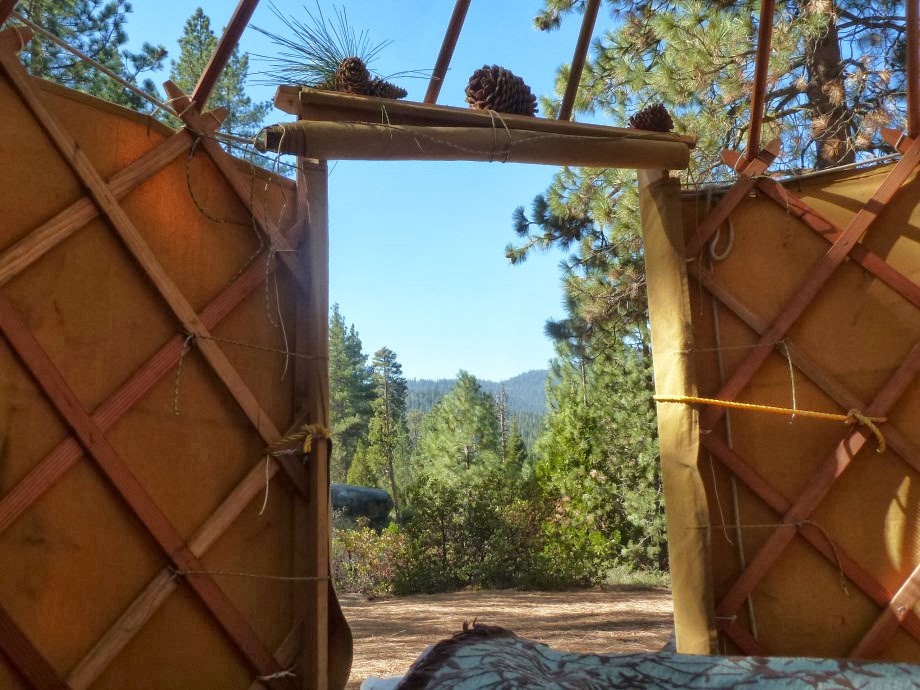
I built a ten foot diameter yurt suitable for camping.  The ten foot diameter seemed suitably large for comfort but not so large as to provide a transportation problem and also not so large as to overflow available camping spots. Our intent was to give it a good workout in Kings Canyon National Park.  By and large, it worked out with minor problems.  Pictures and comment below.

This shot was meant to show how small the yurt looks in a natural setting.  It looked much larger when I first set it up in the driveway of our house. We left the roof cover off so we could look at the stars at night.
Here is a picture of the yurt in the afternoon when the sun is hitting it.  We peeled back the wall for better air circulation.
Here is the yurt with the roof cover on.  We may still sew darts into the overhanging portion of the roof to take up the wrinkles.
After we got kicked out of Kings Canyon due to government shutdown, we found a camping spot in Sequoia National Forest right next to a Jeffrey pine.
Here is a longer shot of the yurt to show its size in proportion to the pines.
And then it snowed.  Clouds moved in in the morning and we put the roof cover on.  I had not yet made a smoke hole cover so a plastic tarp had to do the job.  The snow all melted once the sun came out.
A closeup on the tension band that holds the top of the wall in against the pressure of the roof poles.
And a closeup of the roof pole to wall junction.
The tarp leaked a little since laid flat over the smokehole ring to which I had not yet added any arch.  Here I have added some willow twigs to remedy that problem.
All in all, we were pretty happy with how the yurt behaved.  Next addition, some flooring to isolate the bedding from the ground and a small wood stove for heat.

Sunday, October 20, 2013

Camping as Space Travel


Camping is often lauded as a way for harried urbanites to re-connect with nature.  Well maybe. Decades ago, I used to go on canoe trips to Quetico Provincial Park in Ontario, Canada, sometimes with friends and sometimes with family.  To do these trips, we had to pack all the food we would need for the length of the trip.  Not packing enough food would mean going hungry since there are no stores in the park.  Then at some point, I took along a fishing rod and caught fish to supplement our meals and surprisingly, my experience of the camping trips changed.
The best way I could describe the new relationship was that it no longer felt like space travel where you had to bring absolutely everything with you that you needed to survive.  Once I was able to catch fish, my environment took care of some of my needs.  I was not entirely reliant on my environment to provide me with food, but I was not entirely reliant on what I had brought with me either.  I felt a new bond with my surroundings.  My surroundings now provided for me.  My presence in the wood and lake country was in a sense approved of by my environment.  I could say that I now filled an ecological niche, that of a fish eater.  I was no longer simply a tourist on a life line that led back to the civilized eco-niche that I had come from.
Yes, I was by no means living off the land simply because I caught a few fish, but the fact that the land I traveled through provided me with at least a part of my sustenance changed my relationship with it.
Camping in Kings Canyon, NP.  The yurt dwarfed by tall pines and the canyon wall.
Fast forward to the recent past.  My wife and I spent a few weeks camping in the Sierra Nevada mountains of California.  We started out at Kings Canyon National Park but were kicked out because of the government shutdown.  After expulsion, we moved on to the Sequoia National Forest where they allow dispersed camping, that is, camping somewhere other than at a designated National Forest campground.  We were now entirely on our own for amenities since the NFS wasn't providing any.  That is, other than a spot to park your car and pitch your tent, the forest service wasn't  providing anything, no toilets, no water, no garbage cans, no bear boxes, no pavement, no wood. Worse yet, because of a prolonged drought, we could not build fires either. We had to stick with our propane fired camp stove.  We were able to manage without toilets and had enough drinking water to get us through a few days at a time before needing to replenish.  But in a way, we were back in space travel mode.  Absolutely everything we needed to survive had to come out of our space module, the family car.
The yurt after our relocation to Sequoia National Forest. 
Not that camping in a  National Park was any better.  If anything, under normal conditions, it was even more restrictive and artificial an experience than camping in a national forest.  In a national park, you are not supposed to interact with the environment in any way.  You can't burn the wood, you can't pick the plants.  You can't hunt the animals, nor feed them, though apparently, you can do some fishing where there are fish.  Mind you, I am not criticizing National Park policy.  I am simply stating the effect it has on the experience of being there which is that it is not meant to be an environment that will support human life. It is an environment that tries very hard to minimize human impact. Any self sustaining activity other than fishing is in effect prohibited.  To return to the space travel metaphor, I don't know whether Star Trek with its prohibition of modifying alien cultures came up with this idea on its own or got it from the National Park Service, but there we were, camping without modifying the environment.  For the most part, it's great to be in a national park because they manage to preserve the landscape in a state that resembles the state it was in before Europeans showed up.  That is, besides some of the most stunning scenery, you also get to see what trees looked like before people cut them all the big ones down.  And unlike the national forest, nobody is using the national parks as cow pasture.
So far I haven't even mentioned backpacking.  Backpacking gets even closer to space travel than car camping.  For backpacking, at least the way it's done these days, you need all sorts of specialized gear that you can only get in a high end camping store.  Everything needs to be light weight, including your food which resembles the food of astronauts.
But you can still have some sort of camping experience that doesn't resemble space travel if you are willing to be creative and accept the fact that you can't have humans invading an environment without having some impact on it.

Monday, August 19, 2013

More Uses for a Two-ton Crane

My neighbor at the shop came up with yet another novel way to use the two ton overhead crane.


Ben floating over the bottom of his boat with his dad in the background steering the crane to move him into position for applying the next batch of resin.


Sunday, June 30, 2013

Plastic kayaks - Pros and Cons

Recently, a friend let me paddle his plastic kayak, a boat that he was quite fond of.  I never turn down an opportunity to try out other kayaks and so I got in this one and paddled away.  The boat looked very pretty with its white bottom and yellow top and was still new and shiny, but the bow seemed too blunt and pushed too much water, creating much noise in the process. It wasn't a flaw that you would be likely to notice just by looking at the boat, but it was readily apparent once you paddle it.
I reflected on this and came to the conclusion that I couldn't be the only person that noticed this problem with that boat.  But given that the manufacturer had already invested in a mold, he probably had to sell a certain number of boats before he could recover the cost of the mold.  Only after that point could he consider making a new mold.  The longer he held on to the old mold, the cheaper the cost per boat would be.
And that, in a nutshell is one of the major problem of mass produced boats.  The thing that makes mass produced boats cheap is that they involve a minimum of labor.  Make a mold, and once you have a mold, you can squirt plastic into it and out comes one shiny boat after another.  But the mass production is a good thing only if you have designed a good mold.  The manufacturer had better built a number of prototypes and tested them for good design before committing to a mold.
If users give the manufacturer feedback on design flaws, he really can't do much until his first mold is payed for. And this is more of an issue for small manufacturers who, lacking deep pockets need to pay as they go.
If you buy a custom boat from an experienced builder, you pay more than for a production boat, but you are also less likely to be a victim of design flaws.  I suspect the custom builder gets to build a lot more boats and gets a lot more design experience than the builder of production boats.  I might be wrong, of course, given that I don't really know what credentials production boat designers have or whether production boat manufacturers even have experienced designers on their teams or just hire consultants or copy someone else's designs.  If anyone knows, I'd like to hear from them.

Thursday, June 27, 2013

No More Spots


The dust motes, like floaters in your eye are most noticeable in the sky which is a uniform color.  They are not that noticeable elsewhere.  In a way, they are cool once you get over the notion that the sky should be a pure uninterrupted blue.  The floater are like nature's graffiti on your sky.
Over time, my camera accumulated dust in the path of the light between the outside of the lens and the sensor that translates that light into digital data.  And it never got better, just worse. This never used to be a problem with the old cameras.  But for some reason it is a problem with the digital cameras.  So I thought that the end of my digital camera was near.  But just for grins, I checked out the handy google find anything on the internet utility and lo and behold, there was a guy in Oakland who removed dust from your camera.
The way he told it, the dust is not in the lens but accumulates on the sensor that translates light to digital data. I'm not sure that that's the only place the dust was that he removed, but the net effect was that for $65, I was able to get a regulation blue sky without spots on it.  We'll see how long that lasts.

Wendy Tremayne and the Good Life Lab


I met Wendy Tremayne through my wife who participated in a Swap o Rama Rama event at the San Mateo Makers Faire.  The Swap o Rama Rama idea was Wendy's and the concept is based on the calculus of what it takes to live a Good Life.  Is it better to be a wage slave and live a crummy life so you can buy commodities with money or is it better to live the life you want and get your commodities by some other means.  Wendy and her partner Mikey did the math and concluded that it was better for them to live the life they wanted and get their commodities by means that involved as little money as possible.
So that's what the book is all about, the math on what it takes to have a decent life when you have a job and money but little time vs. having a decent life when you have no job and little money but all the time to do what you want. Plus, having done the math and concluding that you'd rather have a good life and little money, how to tap into the waste stream to get the commodities you need and developing skills to do stuff on your own that you used to pay other people to do when you had money but no time.
And having had some time to talk to Wendy, I also found out that she is one of those genuinely authentic human beings that radiate a goodness that outshines any ego that might still be clinging to their bodies.
Quitting your job to live the good life is obviously not for everyone, but if by some stroke of luck you get fired and can't find another job, you should maybe get this book and look at some alternatives.
For a more in depth review of the book you might also want to look here. The review also has an interview with Wendy.
Perhaps the best part of the Wendy approach to the good life is that is not a fixed prescription but rather a more general approach, that is, living off the waste stream of our culture is not a permanent solution, but rather a way to live right now while there is a large waste stream.  If that waste stream were to dry up, then some other way of living will be needed, but for now, it's a good way to go.

Just-In-Time Upcycling

In the old days, like back as far as the 60's people used to re-use stuff.  Then along came re-cycling which was not the same as re-use.  Re-cycling meant grinding stuff up and then using it as feed stock for something brand-new.  Old stuff was passe. New stuff was hip.  Recycling was something that hippies did.  Re-use was something your mom or your grandmother did. That is, your mom didn't throw away your old clothes but patched them up or made them last a while longer by maybe altering them or embroidering on them or turning old stuff into quilts, or your dad would take bent nails and pound on them with a hammer till they were straight again and could have another life. 
And then, stuff became so cheap that re-use became too quaint for any reasonable person to countenance.  Re-use became more expensive if you counted your time than simply throwing stuff away and buying new.  That was in the days when people had jobs.
But now that jobs are going extinct, more and more people don't have jobs and all of a sudden, re-use isn't such a stupid proposition.  But re-use isn't a cool name for what we are doing and instead it has been re-branded as up-cycling. Whatever. 
It is what it is and little by little, more and more people are tapping into the recycling and waste stream and extracting materials from it that once upon a time were practically worthless.  Instead of grinding everything down to pulp and then squirting it out of some machine to make new stuff, more and more people are taking the practically worthless stuff and using it as is or modifying it just a little to fit their own use.  Nothing new, really, but as more and more people do this, the stuff that used to be worthless will become more and more precious.  With nobody having jobs and the money to buy the new stuff made from old stuff, the old stuff as is without being recycled will become more expensive.
So this is where the concept of just-in-time upcycling comes in.  You have to grab stuff out of the waste stream and modify it to suit you while you can, before everyone else realizes that this is where it's at and makes the stuff that is now being thrown away into an expensive commodity.
Check out Wendy Tremayne and The Good Life in my next post for more on this topic.

Good News!! Tapping the Waste Stream

While the world economy as a whole might be circling the drain and every other country is having watercanon fights with its citizens, here in Alameda, we are making do with what we have, namely, leftover stuff from the times of plenty.  All this sort of thing is given catchy names like upcycling, diverting the waste stream, etc.  what it comes down to is that if you can't afford new stuff, you might want to use some old stuff instead.  And so the dog - woman boat featured a few posts back was made almost entirely out of old stuff, not as a stunt but out of necessity, the necessity being that when money is scarce, you make do by other means.
The builder, Inka had access to various pieces of cast off wood from her building jobs and the skin of the boat was made of scraps that I had left from other boat projects that Inka then sewed together on a friend's sewing maching.  For the coaming rims, we scavenged some branches from weed trees in the neighborhood and when it was all done, we had a boat that for the most part wasn't that much different from a boat that we would have built had we used all new materials. 
Skin of sewn-together pieces from other projects, giving the boat a traditional look, although from a distance, you can hardly see the seams.
And that in a nutshell is what boat building in the Arctic was like in the old days.  You had to scrounge all the stuff you made your boats out of.  Takes a little more time than buying everything fresh at the boat supply store, but worth it, especially when you have more time than money.
So if you have more time than money, contact me and I will tell you how to make a boat from found materials.

Moving Boats


Jan Adkins wrote a book called Moving Heavy Things.  The other day I decided to use the two ton crane at the shop to lift a kayak up into storage.  A bit of overkill for a 40 pound boat, but what the heck. The thing was unwieldy and sometimes a crane is just the thing to use, assuming of course that you have one.


Hook it up,

and hoist it.
And of course, sometimes your boat is actually big enough to require a crane, this time, the Italian Americas Cup boat, Prada going from the concrete apron into Alameda's seaplane lagoon.

Hot Air Wood Bending

NOTE to readers:
This particular post has gotten the most traffic of all my posts for a while now.  Is there really that much interest in wood bending?  I would remove it if I thought that this post draws readers to my page by mistake, but then again, I'm willing to leave it up with the hope that would-be wood benders might also be interested in kayak building.  So other than that this page skews the statistics for this blog, no real harm done.  Hot air wood bending, really? Who would have known.

Steam bending of long pieces of wood requires a long steam box and a lot of time to get the steam box heated up.  So unless you intend to steam a lot of pieces, waiting for the box to heat is a pain.  Instead, we did some hot air bending.  The wood, black acacia had soaked to the point of sinking and so was thoroughly saturated with water.  So with a hot air gun and lots of clamps, we heated a few inches of wood at a time, bent, clamped and then moved on.  Simplicity itself.
Heat the inside.


Heat the outside, bend and clamp.
All done.  Wait for the thing to dry, remove clamps and glue.

Woman - Dog Boat

Inka Petersen launched her two hatch baidarka yesterday.  One hatch was for her, the other for her dog, Rosie.  The boat was a bit of a challenge to design since its volume was fairly small - total length 15 feet by 22 inches wide.  With low free board, proper trim becomes more important.  So we launched the boat.  I will let the pictures tell the story.
The boat empty. Trim good.

The boat minus Rosie.  Needs ballast.

The boat with Rosie in the dog seat. Trim pretty good.
Actually, part of what contributed to the trim inequity was that none of the seams had been sealed yet and the boat was taking on water fast and heading for the stern.  Still, we all were happy, christened the boat with some Anchor Steam, a local SF brew.  I was hoping for some Alaskan Amber but the supermarket wasn't handling it. Plus I got a swim in.