
Glad you asked. As everyone probably knows by now, former military bases are the equivalent of toxic waste disposal sites. The military, at least on US bases has cleaned up its act and complies with various environmental laws. Overseas is another matter. But for now, let's focus on the US, more specifically on the former Alameda Naval Air Station (Alameda, NAS) where my shop is.
In the past, the military dumped anything and everything liquid on the ground or down the sewers and after that, it was out of sight and out of mind. Back then, dilution was the solution.
Nowadays, things have changed. The stuff the military dumped in the ground or down the sewers is still there, clinging, slowly dispersing, looking for a place to go.
Meanwhile, the cold war ended, Clinton closed military bases and the department of defense looked for buyers for their decommissioned bases. Developers vied to tilt up condos and strip malls on the abandoned bases. But wait .. enter, stage left, the lawyers. The military has them and so do the developers. Somebody discovered that there was BAD STUFF in the ground and lawyers got wind of that. The long and the short of it is that the military's lawyers determined that stuff in the ground meant lawsuits down the road. Build a house on top of the toxin infused dirt and somebody's kid gets cancer. Kid's parents file a lawsuit, find a sympathetic jury and the military owes way more money than they sold the base for.
Enter the cleanup crew. The lawyers said, no lawsuits. Hence clean it up before the military sells it. Expensive, but what the heck, cheaper than a lawsuit. So here we go.
Coming back to the Alameda NAS, not only did the Navy dump fluids in the ground, they also flushed various radioactive materials down the sewer. Again, this was small scale stuff, like the radioactive material that went into military instruments to make the phosphors in the various gages light up. But there it sat in the sewer line, waiting for a lawsuit.
But, the lawyers found out and the cleanup started. It will be over soon. The fences will come down. I will have access to the water once again. Pictures to follow.

That little sliver of water to the left has a little beach abutting it at low tide. The Navy put up a chain link fence to keep people off the beach. Reason? Apparently, the sand and mud of the beach is saturated with toxic chemicals. If people play on the sand, the toxins get into the water when the tide comes in.

There's signs in at least four languages telling us not to go near the water or eat fish or shellfish that live in it. This sign is in Chinese. Other signs are in English, Spanish and Vietnamese.

The yellow building to the left is our old shop building. We have been kicked out of it. The white building to the right is the source of solvent contamination. The solvents are in the ground, working their way in the direction of SF Bay. The white trucks are there to transport contractors who put probes down in monitoring wells to find out how far the solvents have gotten.

Meanwhile, on the other end of the seaplane lagoon, the radioactive cleanup is going on. The fence at the left which is converging toward the horizon runs parallel to the sewer line that drained the radioactive materials into the bay.

Here's another view, this one of the guard shack at the far left and blue water containers to the right of the shack. The water containers fill up spray trucks which run back and forth and keep everything wet so radioactive dust does not get blown about by the wind.

Here is a pile of toxic dirt. It has been sprayed with something that binds the surface and prevents the wind from disturbing it.
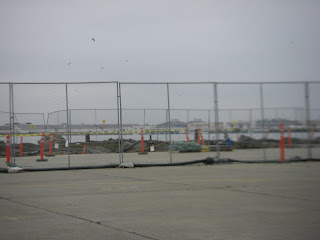
And here is the last of the work to be done. Beyond the fence is a trench in which the new sewer line has been laid so that it can now drain clean, unradioactive water into the bay.
Postscript:
Actual radioactive material that got into the sewer is probably minimal. Nobody on the site is wearing lead suits. The whole thing is probably a boondoggle with the prime beneficiary being the toxic remediation contractor. Nevertheless, we, the taxpayers benefit from all this activity because it is still cheaper than a lawsuit.
Meanwhile, I am waiting for it to be all done so the fences can come down and I will once again have a nearby place to launch my kayaks.
 model of three-hole baidarka by Sergie Sovoroff at the Alaska State Museum


