In this post I want to focus on ways to design a paddle so it orients itself in the proper direction for paddling without a lot of effort on the part of the paddler. A paddle that requires a tight grip to keep it in control will sap the energy of the paddler and cause fatigue and diminished efficiency.
Not surprisingly, there is more than one way to make paddle orientation easier to control. I will examine three different ways all of which can be used in various combinations. I should also mention that the intended use of the paddle, whether it is meant for racing, cruising, surfing or rolling will have an impact on how it should best be held.
Most traditional paddles have oval or egg shaped looms with the longer dimension of the oval perpendicular to the face of the paddle blade. The oval shape makes it easier to keep the loom from twisting in the hand than a loom with a circular cross section.
A second way to keep the loom from twisting in the hands of the paddler is to hold the paddle at least partly by the root of the blade where it joins the loom. For instance, in a shouldered Greenland paddle, the index finger and the thumb circle the loom while the other fingers and the rest of the palm circle the root of the paddle blade. The flat part of the blade resting against the flat of the palm gives the paddle stability and keeps it from rotating in the hands of the paddler.
I thought at one time that it was only the Greenland paddles that were held this way, but there are some photos of Unangan (Aleut paddlers) that also show them holding their paddles so that at least part of their hand is on the root of the blade and part on the loom.
A third way to stabilize a paddle is to design it so that the paddle blade naturally wants to orient itself in the right direction when the paddler pulls on the loom. This trick only works for paddles that are asymmetrical, that is paddles that have a front face that is different from the back face. When you pull this kind of paddle through the water at some random angle, it will have one face that will naturally orient itself in the direction of travel while the other face orients itself away from the direction of travel. It is like a wind vane which if put sideways into the wind will turn its head into the wind and its tail out of the wind. Examples of this kind of paddle are the Unangan (Aleut) paddle and bent shaft paddles in which the face of the blade slightly trails the loom as the paddle is being pulled through the water.
In these two closeups of Unangan paddlers from the same boat, both paddlers are holding the paddles with the flat face toward the back. The interesting thing with these paddles is that the weather vane effect would favor holding the paddles flat face toward the front but the shape of the paddle in the areas where paddlers held it also make the opposite orientation stable. The photo was no doubt posed and both paddlers are just holding the boat in position rather than paddling forward. They may actually be paddling backward. So it is hard to tell whether this is the way they held their paddles when moving along, but regardless of what was happening when the picture was taken, it seems that the shape of the loom allows the paddle to be held in a stable manner regardless of orientation.
This also brings us to the question why so many commercial paddles have looms with round cross sections while traditional paddles almost without exception have looms with oval cross sections. I suspect the reason is that is simply so much easier and cheaper to manufacture looms with round cross sections.
This blog is about various boat and environment related topics that I care to comment on. First and foremost, this blog is about skin on frame boats, their construction and use, as well as paddle and other stuff related to skin boat use.
Monday, March 19, 2012
Wednesday, March 14, 2012
Paddle Design - Prologue
I've had two different prototype paddles kicking around for a while that I was not able to get to the point where I liked them. What I typically do when I build new paddle designs is to overbuild them and then whittle away at them until they work to my satisfaction, or at least until their performance does not improve any more. Sometimes, it is just not possible to rescue a paddle design. I have to walk away from some paddles and simply write them off as a learning experience. I generally have no idea how a new paddle will work until I actually try it out. I would like to say that the more paddles I build, the better I get at predicting paddle performance, but I would be lying. The only way I can tell what design will work is to actually build it and try it out.
Both paddles are versions of an Unangan (Aleut) design. The Unangan paddles are asymmetrical with the loom offset from the plane of the blades.
And so I had my test paddles, test boat and test pond, San Francisco Bay. Even though I had whittled away at both paddles and tried to improve their feel, I preferred the one piece paddle because it was lighter and seemed to move the boat with less effort. The breakdown paddle felt heavy and more ponderous in the water.
After the initial test I did a little more whittling and then took out both paddles again and this time I had my GPS with me. The GPS gives me a speed readout which I can use to measure top speed for a boat or paddle and if I have two or more paddles, it gives me top speed for comparative effort. Effort expended is pretty much a subjective measure but on a given outing, swapping paddles back and forth several times gives me a pretty good idea of comparative efficiency of two paddles.
And this is where the GPS comes in. Although one paddle may feel better than another the one that feels worse may actually be giving me a better top speed. It may feel worse because it moves more water and makes me work harder. But if I am simply cruising, comfortable feel of a paddle may be more important than top speed. Comfortable feel may also be an indication of better efficiency of one paddle over another.
So to sum up, paddle design for me is a pragmatic exercise. I have to test paddles on the water to tell whether they are any good and results are often surprising. In a future blog, I will get more specific on factors that make for a good match between paddler, boat and paddle.
I should also mention that a paddle must be matched to the boat as well as the paddler to perform well. A paddle is not a good paddle in the abstract. A paddle is a good paddle only for a specific set of conditions. In this case, I happened to have my King Island kayak readily available and that became the test platform. The King Island kayak was fairly well suited to this particular paddle test because the King Island kayak's high deck calls for long paddles and the set of paddles I was testing were fairly long, 98 inches. I had already modified both paddles based on previous tests. One paddle had started out at 102 inches long and I cut it down and the other had a loom that was way too fat for comfortable use and I had slimmed down the loom on it. The thing about the fat loom was that it felt good in the shop, but out on the water in action, it was just too bulky.
Here's a shot of the inside of the King Island kayak. Note the high deck ridge. The thing about a high deck is that it forces you to hold the paddle up higher which means that it has to be longer to reach the water.
And here is a shot of the two test paddles on the deck of the kayak. The lower paddle was based on a paddle shown in an old illustration. The upper paddle is a breakdown version of a more conventional Unangan shape except for the loom.
Both paddles are versions of an Unangan (Aleut) design. The Unangan paddles are asymmetrical with the loom offset from the plane of the blades.
And so I had my test paddles, test boat and test pond, San Francisco Bay. Even though I had whittled away at both paddles and tried to improve their feel, I preferred the one piece paddle because it was lighter and seemed to move the boat with less effort. The breakdown paddle felt heavy and more ponderous in the water.
After the initial test I did a little more whittling and then took out both paddles again and this time I had my GPS with me. The GPS gives me a speed readout which I can use to measure top speed for a boat or paddle and if I have two or more paddles, it gives me top speed for comparative effort. Effort expended is pretty much a subjective measure but on a given outing, swapping paddles back and forth several times gives me a pretty good idea of comparative efficiency of two paddles.
And this is where the GPS comes in. Although one paddle may feel better than another the one that feels worse may actually be giving me a better top speed. It may feel worse because it moves more water and makes me work harder. But if I am simply cruising, comfortable feel of a paddle may be more important than top speed. Comfortable feel may also be an indication of better efficiency of one paddle over another.
So to sum up, paddle design for me is a pragmatic exercise. I have to test paddles on the water to tell whether they are any good and results are often surprising. In a future blog, I will get more specific on factors that make for a good match between paddler, boat and paddle.
Sunday, February 12, 2012
Yurt or Skin on Frame Portable Dwelling
I haven't done much boat building lately since I have been busy working on a yurt. Though this blog is supposed to be all about skin on frame boats, I thought it would be OK to indulge in some related skin on frame construction, namely, the yurt or portable dwelling.
The idea of building a yurt came to me after last year's October camping trip. We were pretty far south but at high elevation and so we encountered snow and cold nights at times. We had an adequate tent and warm sleeping bags but the sun went down early each day and then stayed away for twelve hours so that once it got dark there was little to do but crawl into the bags and listen to books on our mp3 players. Camp fires and eating are usually good camping entertainments, but most campsites have fire rings that keep the heat of the fire away from the camper and otherwise hamper what should be a good entertainment. Likewise, cooking food when it is near freezing is possible but once the food is done, it gets cold in a hurry and then you have to clean up in the dark and cold.
So the idea of a tent that was big enough to stand up in and build a fire or set up a camp stove in and cook in and eat in, all in comfort and warmth wormed its way into my consciousness. The idea of a tipi came to mind, but those require long poles and a lot of canvas and would add a lot of bulk to an already bulky camping load. So then I thought about yurts. And as a little research showed, there were lots of articles on the topic on the internet.
In addition, my neighbor, Tim Anderson had built a yurt and so I could use him as a technical adviser. So off I went on the yurt adventure. I quickly found out when doing the research that everyone builds yurts their own way and nobody seems to tell you much about general principles like how strong to make the walls or what the pitch of the roof should be, whether the thing will hold up to a snow load, heavy winds and so on. And so I decided to build a prototype yurt that could sit behind the shop. I would use it to work out the design details and once that was done, I would build a smaller more portable and lightweight yurt for camping.
So here goes with the photos.
The target diameter of the yurt is 16 feet so I needed to construct 48 feet of wall. Circumference of a circles is pi times diameter of the circle, remember?
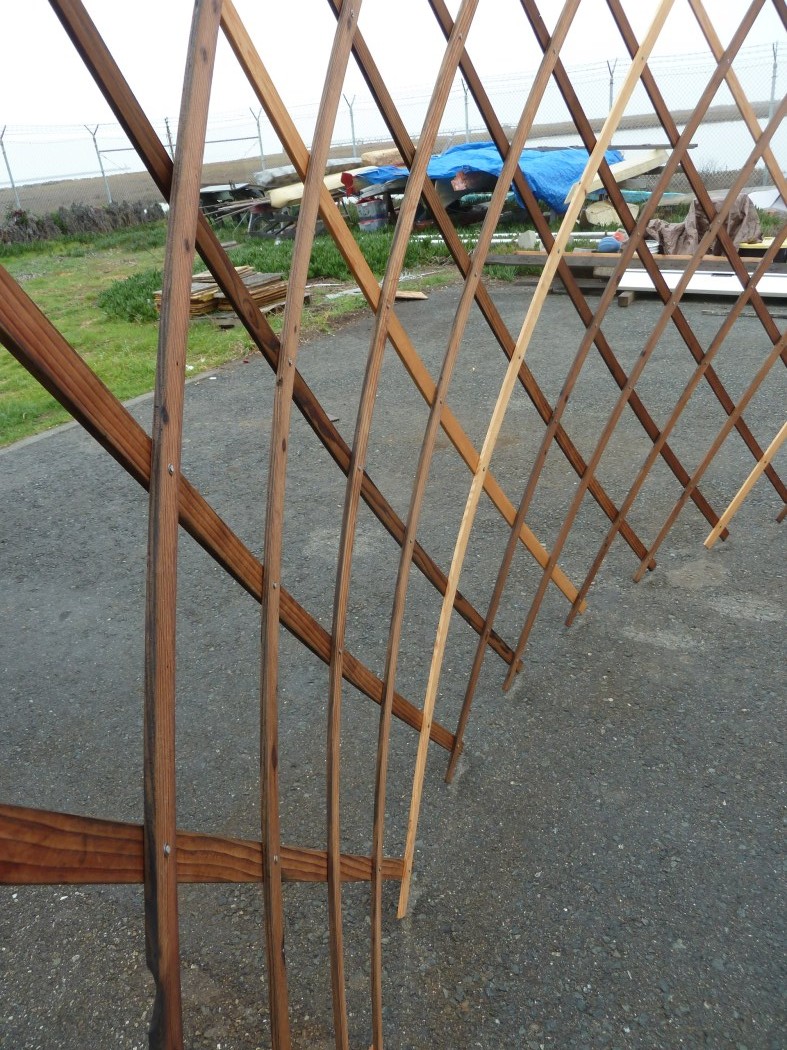
And here is one section of the wall, all folded up into a 30 inch wide section. When unfolded, this represents 24 feet of wall.
When the two sections of wall are joined as shown here (temporary joint made with clamps) the wall is complete. And the 96 inch long slats at an angle make the wall 72 inches tall.
The other two ends of the two wall sections will get connected to a door frame, not yet built. Note alternating colors of wood. I had enough old redwood deck boards to make almost the whole wall but had to buy a few extra doug fir two by fours to top off the number. The redwood was free and light. The doug fir was about ten dollars total and stronger than the redwood but also heavier. We will see how they hold up over time.
Stay tuned for door frame, roof and canvas cover yet to come.
The idea of building a yurt came to me after last year's October camping trip. We were pretty far south but at high elevation and so we encountered snow and cold nights at times. We had an adequate tent and warm sleeping bags but the sun went down early each day and then stayed away for twelve hours so that once it got dark there was little to do but crawl into the bags and listen to books on our mp3 players. Camp fires and eating are usually good camping entertainments, but most campsites have fire rings that keep the heat of the fire away from the camper and otherwise hamper what should be a good entertainment. Likewise, cooking food when it is near freezing is possible but once the food is done, it gets cold in a hurry and then you have to clean up in the dark and cold.
So the idea of a tent that was big enough to stand up in and build a fire or set up a camp stove in and cook in and eat in, all in comfort and warmth wormed its way into my consciousness. The idea of a tipi came to mind, but those require long poles and a lot of canvas and would add a lot of bulk to an already bulky camping load. So then I thought about yurts. And as a little research showed, there were lots of articles on the topic on the internet.
In addition, my neighbor, Tim Anderson had built a yurt and so I could use him as a technical adviser. So off I went on the yurt adventure. I quickly found out when doing the research that everyone builds yurts their own way and nobody seems to tell you much about general principles like how strong to make the walls or what the pitch of the roof should be, whether the thing will hold up to a snow load, heavy winds and so on. And so I decided to build a prototype yurt that could sit behind the shop. I would use it to work out the design details and once that was done, I would build a smaller more portable and lightweight yurt for camping.
So here goes with the photos.
The target diameter of the yurt is 16 feet so I needed to construct 48 feet of wall. Circumference of a circles is pi times diameter of the circle, remember?
Here's a closer up view of the wall with another semi-nomadic structure behind it. Nomadic if movable by fork lift fits your definition of nomadic. In any case, for the sake of convenience the wall of a yurt is usually constructed in sections so that each section is of a size that is easy to lift and not too wide to transport.
And here's a shot that tries to show the curvature of the lattice wall. Hard to visualize this sort of thing until you actually build the wall.
Intersections of the wall slats are held together with clinched nails, that is nails whose tips are bent over and hammered down and buried in the wood.
Here's a view of the junction from the other side where the tip of the nail is buried in the slat.
And here is one section of the wall, all folded up into a 30 inch wide section. When unfolded, this represents 24 feet of wall.
When the two sections of wall are joined as shown here (temporary joint made with clamps) the wall is complete. And the 96 inch long slats at an angle make the wall 72 inches tall.
The other two ends of the two wall sections will get connected to a door frame, not yet built. Note alternating colors of wood. I had enough old redwood deck boards to make almost the whole wall but had to buy a few extra doug fir two by fours to top off the number. The redwood was free and light. The doug fir was about ten dollars total and stronger than the redwood but also heavier. We will see how they hold up over time.
Stay tuned for door frame, roof and canvas cover yet to come.
Tuesday, January 24, 2012
Hot Springs Village Archaeological Site
Since we just got done looking at traditional Unangan beliefs I thought I would mention a website that features amulets from The Hot Springs Village archaeological site. The site lets you rotate the pictures so you can view the amulets from all sides. If you're interested in carving your own, this is a great place to go for source material.
As the home page indicates, the source culture of the amulets is uncertain. Apparently the place where they were found is right on the border of the Alutiiq and Unangan territories and so which culture made the amulets or whether more than one culture influence them is uncertain. All the same, there they are, regardless of who made them.
Traditional Unangan (Aleut) Beliefs
Jeff Dickrell who teaches history at Unalaska High School in the Aleutians has been working on a history of the region. The following material is an excerpt (with permission from Jeff) from his as yet unpublished book on the topic of traditional Unangan (Aleut) beliefs.
As I read the list of beliefs, it occurred to me that beliefs and ritual or religious practices and charms and amulets were as much a part of paddling a small kayak on a large ocean as the more mundane kayaks and paddles themselves. Obviously, the paddler's craft and personal skill and strength did much to keep him alive on the ocean, but in spite of this, people still drowned or were blown into oblivion and so, the prudent paddler sought out help from the supernatural realm to augment what help there was from the natural realm.
So, without further ado, here is the excerpt from Jeff's book. The excerpts are followed by a set of notes on the origins of various quotes which are followed by a bibliography.
![]() |
| This carving was collected by archaeologist William Laughlin, probably near Umnak Island. . It is possible that the groove was used to attach hair to the head of the figure. |
So, without further ado, here is the excerpt from Jeff's book. The excerpts are followed by a set of notes on the origins of various quotes which are followed by a bibliography.
Aleut Traditional Beliefs
(Jeff Dickrell, Author)
The superstitions of the Aleuts were innumerable. Every activity or undertaking and almost every step required its own and often elaborate signs and talismans[1].
Mixing Different Elements
Like all other cultures on earth, the Aleut people had an elaborate array of spiritual guidelines to assist them in thriving in a harsh environment. This, of course, extended to kayaks and their owners. There were things to do to assure success in hunting, things not to do to stay on the good side of nature, things to carry to bring luck but probably the most important guideline was to keep pure by never mixing different elements together.
Separating Environment and Gender
There were two main elements that required separation, environment and gender.
This meant could not be mixed, nor could things from the sea and things from the land. For example, stones which came from the land and were placed in the kayak for ballast, had to be returned to the beach.
Never Throw Ballast Stones into the Sea
It is regarded as a sin to throw the ballast into the sea. The stones must be brought to land from where they were taken, otherwise the boatman, it is believed, will be drowned. Even when the load of the skin-boat becomes too heavy from the returns of fishing or hunting, the stones have to be brought to the shore.[2]
Clean Feet Before Entering Kayak
This meant that when a kayaker was leaving the beach he had to make sure he wasn’t inadvertently bringing grass, sticks or any vestige of the islands. Often washing the bottoms of the feet was part of the preparation ritual. In 1909, Arseniy Kryukov of Umnak, told Jochelson that sea otters would not be afraid of a hunter who, in the early morning before he went hunting, rubbed himself with seaweed or shellfish, or at least walked the shore.[3] This would allow the hunter to blur the line between the sea and land.
Keep Anything Female Away from Hunter and Kayak
Just as important as keeping the land and sea separate, was keeping anything remotely female away from the hunter and his boat. This means physical things, like hair, which, if sewn into the seams (sometimes intentionally) of a boat’s skin or his kamleika, would cause him to have bad luck in hunting. It was said that if a bit of woman’s juju remained on a hunter, a sea lion would bite out the offending piece, and perhaps a chunk of the paddler as well.[4] Merck noted the same was true if a man’s hunting gear was in the vicinity of a childbirth.[5]
Men Sew the Last Seam of the Kayak
One counter to this, since women sewed the skin of the kayak, was for the man to sew the last seam after the skin was pulled on the frame. This seam, just behind the cockpit, is very noticeable when looking at museum specimens. All the other seams are beautifully done, flawless in their lines, tufts of wool or feathers sewn into them and then ‘man’s’ seam, sloppy, wandering and obvious.
Women Are Very Powerful
A woman’s sexual organs were so powerful that it was forbidden for females to even step over a kayak, exposing the boat to the negative powers. A woman who experienced her first menstruation was so powerful that she was quarantined so that she would not inadvertently contaminate anything. Interestingly, such an isolated girl could relieve seasickness by warming the patient’s food in her hands.[6] Subsequent to the first menstruation, women were considered unclean during their periods, and were to be avoided, especially sexually.
Abstinence Before Major Undertaking
Having sex with a woman was considered taboo before a major undertaking, “otherwise frightful misfortunes and a cruel death befell the transgressor.”[7] That is, unless you were going sea otter hunting,
Only the sea-otter hunter was not subject to such penalties, but he had no luck in the event. Even when surrounded by sea otters he could not kill a single one. The sea otters, as it were, mocked him. Cavorting around his baidarka, they would tease him and splash him with water but they would not let him hit them with a [cast]. The sea otters do exactly the same to him whose wife, during his absence, does not remain faithful or whose sister, before her marriage, does not preserve her virginity.[8]
Share with Your Kayak
If a man did have sex the night before he was to paddle, there was a very important ritual that had to be performed the next morning. An important obligation of the hunter was sharing his sexual life with his kayak. After having slept with his wife or other female the male hunter was obliged to "rub" his kayak the next day. Failure to share the experience resulted in damage to the kayak and failure of the man to return to shore.[9]
The Little Thing She Gave Me
There was a way to have your cake and eat it too, that is have sex the night before a sea otter hunt and still be successful. In 1909, Isidor Solovyov told Jochelson about a hunting trip, the night before which he had had a woman, “as his wife”. But the next day, while hunting, he killed six otters. The difference, “the little thing she gave me”, was an amulet of some kind.[10]
Powerful Amulet
Amulets or talismans were carried or worn by the individual. They could be crafted, or something rare from nature, a stone or piece of animal or the most powerful, something from an esteemed elder or better yet, a deceased strongman. They could be something made, given or found, something shown or something hidden. Many of the things had ying and yang characteristics, if great powers were derived from the amulet, it may reduce one’s lifespan.
Mysterious Belt Knot
According to Veniaminov, the most common was “a belt, plaited of sinew or grass, spoken over [with an incantation] and with mysterious knots”.[11] According to Laughlin, one of the most powerful was, “was the caul in which a person had been born: this was carefully dried and, important, kept dry”.[12] Khlebnikov stated in 1823 that, “Pieces of hematite were used as amulets under the name of a’xsix’. They were worn by every hunter, and are said to have the power of attracting sea-mammals particularly whales and sea-otters”.[13]
Cagax̂
Khlebnikov compiled quite a list of cagax’ used by the Aleuts. Some of these were put on fishing nets, carried while fox hunting or tied to a fishing pole. Herbs were tied to fishing hooks, and incantations spoken over them. [14]
Bird Feathers
Feathers or wings of birds such as the Albatross, Rosy Finch or the beaks of a raven were carried or attached to spear points.
Falcon Feathers
They believe the feathers of falcons have special attraction for the otters. Whoever has these feathers attached to the outside of his boat is unusually fortunate on the sea otter hunt. But it happens very seldom that anyone has these feathers, because they fear killing the falcon, because of their taboos. Not only are the otters supposed to be without fear of boats, which are adorned with such feathers, but they are actually supposed to be attracted to that boat.[15]
The power of the falcon’s feathers was evident when Vitus Bering first encountered Aleut’s in kayak off the Shumagin Islands. They were approached by two men in single boats, one of whom raised a staff with two falcon’s wings tied on the end. With a laugh he threw the staff into the water towards the Russian ship.
Chimkiix
A stone found on the beach called, chimkiix, was “exceedingly rare and therefore very highly prized”.[16] It was shaped like a turnip or sea urchin, and was hollow and smooth on the outside. There were two color patterns, white with yellow stripes (considered the male) and red with white stripes (female). Stones found inside sea lion stomachs were kept as used as talismans.[17]
Amber
Amber, which is naturally found on just a few islands, was highly prized. On Umnak Island, it was collected in a unique way. The method of procuring it was as follows: on massed baidarkas, they approached the very wall of the cliff, and by use of long poles dislodged the amber from above, letting it fall onto sea otter skins, spread over the baidarkas, fur-side up.[18]
This source of amber was highly desired and was fiercely guarded by the local Aleuts and trespassers were killed.[19]
Sea Otter Rituals
As sea otter hunting became the most important economic activity, it developed many rituals. Because sea otters were considered transformed humans, they were attracted to things humans liked so, “they made every effort to decorate their baidarkas, their kamleikas, and spears as finely as possible, supposing the sea otter, loving women’s handiwork, would come of his own accord to the hunter who is a dandy”.[20]
Sea Otter Amulets
In addition to looking good, sea otter hunters must be pure, disciplined and shun women. One of the most common elements of the sea otter hunt was a small, four-inch or so, carved figure of a sea otter on its back, hands to its face. These carvings of bone or ivory are placed inside kayaks, on the deck or carried by the hunter himself. There are many samples in museums around the world.
Asxinan
All sources agree that the most powerful talismans that could be used were pieces of the asxinan, the departed ones, sometimes called ‘the dried ones’ or as we know them, mummies. Entombed in caves and secreted away in nooks and rock overhangs or buried under house floors, the mummified bodies of deceased Aleuts were full of immense power.
It is from these corpses that the hunters sought especially to cut off a portion of the body, preferably a joint of a hand, or the small finger, or at least a fragment of clothing. The person who possessed this item was, indeed more fortunate in the hunt, but he almost always died prematurely and a horrible death, his body beginning to putrify while he was yet in his best years.[21]
After a prominent person had died, they would have been eviscerated, placed in the fetal position and wrapped in skins and placed in a protected place, sometimes even within the house. A bentwood bowl was placed underneath to collect the dripping. This too was used as a talisman.
The fluid obtained from the tissues of a dead body was regarded as a most powerful charm. A man whose hands were anointed with such a fluid was able to fight everything and everyone, but this charm was harmful to its owner -his life was short.[22]
Part of the ritual process of gaining power from the supernatural was to have a secret spot to store the amulets away from contamination by women (especially menstruating women) or moisture.[23] These places must be accessed only stealthily, so that no one sees the hunter accessing it.
Audagadax (Sacred Sites)
In addition to the hiding places, each village had its audagadax, or sacred sites which were, …some mound or an off-shore rock or some outstanding feature, on a cliff, which were strictly prohibited to all women and young men. Particularly prohibited was taking even a blade of grass or taking a pebble from there. If any young man, either out of audacity or curiosity, violated this restriction, such a person did not escape punishment.[24]
According to Veniaminov, these sites were used on occasion for the giving of offerings. Individuals (mature men only) would usually leave skins to receive luck in war or hunting. Other offerings were the feathers of rare birds for more general blessings of safe journeys or the calming of the wind.
The rite itself consisted in the following: the [person who] made the offering, having taken the indicated feathers, dipped each one in a pigment, mostly green or red, and threw them toward all four quarters. Each time when he threw a feather, just then he made his request to the invisible spirits, that is, asked for success either in war or in the hunt or for calming the wind, etc. Then he tossed a feather into the air, exclaiming, “nung aqasaxtxin”, that is, “Bring me or Give me”.[25]
Weather Ritual
In 1791, G. Sarychev took a kayak trip around Unalaska. When he got to the small village of Kashega, the weather turned bad. The storm lasted several days and the villagers took action.
The Aleutians becoming at length quite tired of bad weather, they one day collected themselves together, men women and children, and repaired to an open field, where having lighted a fire, and turned themselves towards the wind, they clapped their hands and screamed with all their might, quietly returning in the full expectation of a favorable change.[26]
Shaman Weather Ritual
Just to be sure, later in the evening a shaman and the toions beat a drum and danced in the barabara to change the weather. Merck observed a similar ritual. [27]
Russian Orthodox View of Aleut Shamans
The role of the Shaman in the Aleutian kayak culture is unclear. They existed, to be sure, but did they, “enjoy great respect,” as Netsvetov, the priest at Atka in the 1830’s recorded, or were they, “not held in great respect,” as Veniaminov, the priest in Unalaska at the same time”?[28] However, Veniaminov admitted that, “[Shamans] were asked for good luck in hunting, longevity, miraculous rescue from dangers at sea, the calming of storms and winds, etc”.[29] As the resident priest, it was in Veniaminov’s best interest to diminish the importance of the shamans.
This may have been why he also stated, “They have no temples or idols.”[30] In the same volume, he notes several examples of destructive idols which shamans placed in caves in central Aleutians.[31] Shelikoff noted that while the Aleuts had no concept of an Omnipotent God, they had belief in a spiritual world.
They have no conception of Divinity, although they say that there are two beings in the world or two Spirits, the one good the other evil. However they have no images of them, nor do they worship them, in other words they have no idols. All they say to describe the two spirits is to say that the good one taught them how to make baidaras and the evil one how to damage and break them.[32]
Kaathaagaathagh (Deity Figure)
The idea Aleuts didn’t have some sort of idols was dispelled by archaeologist William Laughlin working on Umnak island from the 1930’s-1970’s. There he found a carved ivory figure about six inches tall called a, kaathaagaathagh, which was identified by Afenogin Ermeloff in 1948[33].
According to Ermeloff, these were deity figures which were suspended from the ceiling of a house and that, “the hunter spoke to the image before venturing out on the ocean and the image spoke back with useful information about weather and the hunt”. The oldest of these figures is 4000 years old. More were found dating up to the Russian period.
Sin of Pagan Ancestors ~ Visiting the Dry One
Another Russian priest, Laverenty Salamatov who was in Atka in the 1860’s, had trouble with the old ways.[34] In the summer of 1862 thirteen men from neighboring Amlia were drowned while hunting around Tanaga Island. They requested a requiem mass form the priest. With my sexton, Aksenov, I went to Amlia……I was met by weeping and wailing inhabitants who were mourning the loss of their brothers, children, husbands and other relatives. What was I to do? All came to me for consolation and I wept with them and consoled them with the words of the Holy Scripture and examples from the lives of certain saints…
But there was a problem. The priest found out that the men, who had been fox trapping on Kanaga Island, visited a renowned mummy cave there, and “were guilty of pagan superstition. I am recording this case as it was reported to me.” Always being afraid of some kind of misfortune befalling them on their enterprises, some of those Aleuts (who were drowned in the sea) committed a sin of their pagan ancestors, namely, they went to visit the Dry One.
The pagan Aleuts paid the same homage to these mummies as to their idols and brought sacrifices to them. When anybody wished to learn about the success of a hunting expedition, he prepared himself with strict fasting, even keeping away from his wife for a definite time; then washed in the river and dressed in his best clothing, he went to the Dry One.
Approaching the cave of the mummy, he cried loudly, “I am coming to you to find out about so and so.” Show me what is to be” He proceeded fearfully to the cave, carrying with him a gift to the Dry One. (Sparkling black paint or ochre and a wing or a feather of a hawk was usually brought as a present) Devotedly he put the gift before the Dry One and left the cave for a while.
The Dry One was supposed to display objects, which, upon his return to the cave, the man observed as signs indicating his future.
Salamatov took the opportunity to preach sermons against paganism and false idol worship.
Finding seal’s hair in the mummy cave the Aleuts concluded that they would have a successful seal hunt before returning home to Atka. Consequently, from Tanaga Island they went to Ulak Island. The forecast of the Dry One did not materialize and they all became victims of the sea. Thus God punishes for the disobedience of his Commandment!
Another parishioner confessed to having consulted the Dried One, “out of curiosity and to find out whether the ancient pagan tradition was correct”. It was, and the priest, “laid a penitence on him and I told him not to believe, not even to listen to, the superstitions and to keep others from doing so.” This penitence lasted nine months.
Charm Seeker
One of the stories recorded by Jochelson in 1909, told by Isidor Solovyov, was called, “The Charm Seeker”. In it, a man, a “weakling”, went on a quest to obtain some “charms”. To do so he paddled to a village, hid his kayak and pretended to be a dead body washed ashore. When the people there brought him into their house, he created a distraction, then leapt up and grabbed the charms from a ceiling beam. He quickly paddled home. From then on, he stayed away from the villagers from whom he stole the amulets. But relying on the charms, he became a successful hunter. “Being paid attention to as a provider, he enjoyed catching sea animals, and his wife was happy too, and his child was happy.”[35]
[1] Veniaminov p. 222
[2] Jochelson p 55
[3] Narratives p399
[4] Laughlin in Cont. p.200
[5] Merck p.175
[6] Laughlin p104
[7] Veniaminov p. 225
For instance, a whale-hunter who violated this rule, before the whale he had wounded died, was immediately afflicted by violent nosebleeds, then swellings over his entire body. Ultimately, he lost his mind and died.
[8] Veniaminov p.225
[9] Laughlin in Cont. p. 200, Narratives p. 225, Old Time Stories p. 209
[10] Narratives p. 81
[11] Veniaminov p222
[12] Laughlin in cont. p. 179
[13] Jochelson p.77
[14] Veniaminov p. 223
This is contradicted by Khlebnikov 1823 p.77
[15] Merck p.171
[16] Veniaminov p.223
[17] Litke p.114
[18] Veniaminov p.75
[19] Veniaminov p.204
“As not everyone could or wanted to buy or exchange these for something, many attempted to get them by stealth. Consequently, the owners of these localities, by right of possession, guarded them and killed the trespassers.”
[20] Veniaminov p 224
[21] Veniaminov p223
[22] Jochelson p 77
[23] Jochelson p77
Veniaminov p218
[24] Veniaminov p. 218
The punishment was, “without fail, a terrible savage disease or speedy death befell him. At the very least, he lost his sanity”
[25] Veniaminov p218
[26] Sarychev p. 67
[27] Merck p169
Young men and women engage in a vigil after sundown. They steal away from the hut with some coal and a few handfuls of straw. A short distance from the hut toward the sea they light a small fire. Around the fire they hop and dance very fast. And as they do they clear their throats with loud shouting as if to frighten the strong storms, or to resist them. And the great calm after the howling of the wind is attributed by them to the great effect of their strenuous activity.
[28] Veniaminov p. 219 and p.367
[29] Veniaminov p. 219
[30] Veniaminov p. 219
[31] Veniaminov p. 366
[32] Shelikoff p. 56
[33] Laughlin in Cont. p174
The ending of this Aleut word, aathaagh, is a diminutive, which implies it is a smaller version of a larger deity.
[34] Documents Relative to the History of Alaska (Vol. II) manuscripts at UAF Polar Collection
[35] Narratives p. 89
Veniaminov: Notes on the Islands of the Unalaska District
Jochelson: Archeology of the Aleutians (reprint) by Waldmar Jochelson
Narratives: Aleut Tales and Narratives by Bergsland and Dirks
Laughlin in Cont. : Bill Laughlin writing in “Contributions to kayak Studies”
Merck: Siberia and northwestern America, 1788-1792 : the journal of Carl Heinrich Merck
Laughlin: Survivors of the Bering Land Bridge
Khlebnikov 1823 Notes on Russian America
Litke : A Voyage around the world, 1826-1829
Sarychev : Gavriil Sarychev Account of a voyage of discovery to the north-east of Siberia, the
frozen ocean, and the north-east sea
Shelikoff: A Voyage to America, 1783-1786
The priest who admonishes his flock is from:
Documents Relative to the History of Alaska (Vol. II) manuscripts at UAF Polar Collection
Labels:
Aleut beliefs,
Jeff Dickrell,
Unangan beliefs
Tuesday, January 17, 2012
John Wesley Powell Descends the Colorado River
This year we visited the Grand Canyon of the Colorado River, a place which gets about 4.5 million visitors a year. Most of these visitors never descend into the canyon and until a century and a half ago, most of the canyon had never been traveled by anyone. Indians of the area descended into the canyon and even farmed and lived there in certain areas, but they were not able to and did not travel along the bottom of the canyon for any distance. Travel at the time was in and out of the canyon but not along the canyon.
John Wesley Powell changed all that. The American Civil War had just ended and Powell who had been a Major in the Union Army organized an expedition to explore the Colorado River and its tributaries. The US was still relatively young. Americans were still moving west and if the movement west was going to go forward in earnest then transportation routes were needed, not only to bring people into the region but also to export resources out of the region. Major Powell was the man to find those transportation routes.
I knew the basics of Powell's story but after my own trip to the Grand Canyon, I pulled Powell's report of his journey off my book shelf where it had sat unread by me for a number of decades. It was time to upgrade my knowledge of this piece of Western history.
I have not finished Powell's book so this is an incomplete report, but this being a boat related blog, I will focus on Powell's means of transportation, that is, wooden row boats.
Powells boats with one or two exceptions were 20 feet long, made of wood with extra frames added for strength. The front and back ends were decked over and closed off to form water-tight compartments in which food and gear were stowed.
The journey began on a tributary of the Colorado river in territory where the canyons were not yet as imposing as farther down the river.
The expedition's first camp is shown here. Notably absent from the picture is any kind of plastic, a substance without which modern camping and river travel would be unimaginable.
As the journey progressed, the canyons became deeper and the expedition encountered falls and rapids. The picture above shows one of the options for dealing with rapids, that is, to run them.
Other options for dealing with rapids were lining the boats down the rapids and portaging. In either case, the usual method was to assemble the boats on shore at the head of the rapids and secure them while scouting the rapids. Where possible, the boats were lined, that is, led down the rapids with lines tied to both ends of the boats.
If the rapids were too severe the boats needed to be unloaded, the gear carried to the bottom of the rapids and then the boats. All this took time and lots of work.
Powell and his crew explored new territory and also inadvertently invented a new sport: river running. This sounds like not that big a deal since totally inexperienced travelers now do this trip every year albeit with experienced guides. But what made it different for Powell and his crew was that none of them knew whether their boats would survive the rapids or what the severity of the rapids would be. They also lacked modern gear and were cut off from civilization for most of the trip. Conditions were sufficiently horrid to make some of the men quit.
Photos are from the National Park Service site.
Labels:
Colorado River,
drift boat,
Grand Canyon,
John Wesley Powell
The iqyax^ and the Sea Otter
A few years ago, a friend of mine gave me a bronze model of an Unangan kayak. This year, my wife gave me a bronze sea otter. Coincidentally, or perhaps not, the sea otter was made to roughly the same scale as the kayak and so I put the sea otter on the deck of the kayak where it looks nice and appropriate and also cute.
The notion of a sea otter on the deck of an Unangan kayak is mostly a fantasy. Sea otters were hunted by Unangan men in the service of the Russian fur traders aka promyshlenniki and later under American rule until the hunt was outlawed in 1911. Apparently, it dawned on somebody in the government that sea otters were near extinction.
So, perhaps coincidentally, the sculptural assemblage of kayak and sea otter is a belated celebration of the one hundred year anniversary of the cessation of the sea otter hunt.
To modern urban sensibilities, the notion of hunting sea otters is abhorrent since they are so indisputably cute even as full grown adults.
But sea otters were hunted for practical reasons, that is, for money that the Chinese were willing to pay for their fur.
The Chinese needed the fur for their aristocracy which needed the luxuriant fur to trim their aristocratic robes as shown above.
The fur, when not attached to an imperial Chinese robe looks like the above. Legal note: Only Alaskan Natives may possess sea mammal furs in the raw. Non-natives may possess art or crafts objects that incorporate sea mammal parts if created by natives.
The Spanish in America, specifically in Baja and Alta California, received mercury in payment from the Chinese for sea otter furs. The mercury was then used to extract gold from ore and the gold was shipped back to Spain to finance wars against other European nations. And so it goes.
Sea otters are safe for the time being. Oil has been found to be much more vital to economic well-being than mercury or gold.
Wednesday, January 4, 2012
Sail Powered Wheelbarrow
Seems like at one time or another, humans have tried putting sails on just about everything including, apparently, wheelbarrows. The online Low Tech Magazine has a cool article on just such technology.
Apparently some of the sails were quite sophisticated, not just pieces of cloth, but battened junk rigs with control lines running back to the handles of the wheelbarrow. This allowed the wheelbarrows to sail at an angle to the wind.
Unfortunately, the wheel is usually on one end of the boat and is small, which limits its use to short distances. With a larger wheel placed in a centerboard trunk, the boat could be transported a good distance. Of course we are now talking integral boat trailer, something which probably doesn't work as well as a conventional boat trailer and results in a boat which doesn't sail as well as a boat without an integral trailer. Perhaps I should just quit thinking about this concept. This sort of one thing does many things poorly design is something best left to the military procurement people.
Apparently some of the sails were quite sophisticated, not just pieces of cloth, but battened junk rigs with control lines running back to the handles of the wheelbarrow. This allowed the wheelbarrows to sail at an angle to the wind.
The Chinese wheelbarrow differed from the European wheelbarrow not only in the size of the wheel, bigger, but also in its placement. The load was balanced on the axle of the wheel which meant that on a level surface, the barrow driver only had to overcome friction. The total weight of the cargo was being carried by the wheel. On a European barrow, the kind that is still being sold here in stores, the weight is centered between the axle of the wheel and the handles, which forces the barrow driver to carry half the weight, limiting the use of the barrow to short trips.
In any case, check out this and other articles in low tech mag.
Which reminds me, every once in a while, you will see articles on wheelbarrow boats in the small boat magazines.
Monday, January 2, 2012
wild food, additional thoughts
If you've read any survival handbooks, you're probably aware that they are not written with the notion of survival becoming a way of life. Survival handbooks assume that due to some accident, you find yourself temporarily isolated from civilization and in need of food, shelter and water. And while you're waiting for the search and rescue team to come and get you out of the pickle you find yourself in, you'd like to stay alive.
Let's assume that you find yourself in a reasonably warm place with water. You probably don't have to do much of anything to stay alive. Drink the water and find something to distract you while you're waiting to be rescued. If you have shelter and water, you can probably get by without eating for a week or more. If there is wild food to be had, collecting and preparing it is probably as good a thing as any to keep you occupied until the helicopter shows up.
But the notion of long term survival in an unfamiliar place is an optimistic one. Let me give my reasons. To stay alive anywhere, you need a good deal of knowledge about the place you are in and the support of your community. If you are lost in the wilderness, chances are, you don't know anything about it and you lack the support of a community. Even if wild food is plentiful and you can recognize it, long term survival depends on knowing how to prepare the food and preserve it for times when it isn't plentiful. A good deal of native knowledge consists not only of what plants and animals are good to eat and how to collect them, but also how to process and preserve them and store them against times of scarcity.
Sunday, December 18, 2011
Inupiat Plant Food
When someone mentions Eskimos or Inuit or people of the Arctic, the stereotype that most often comes to mind is snow houses and people in fur parkas eating whale blubber. However, as short as summer in the Arctic might be, people there eat plant food along with animal food. As a matter of fact, people of the Arctic eat a wide variety of plant foods. And we are fortunate to have a book with an extensive list not only of what they are but also how to prepare them.
The book is called, "Plants that we Eat." Although the book focuses specifically on plant foods that are part of the Inupiat diet, the listing for each plant also includes a map of Alaska that shows the range of the plants. And although different Alaskan Native groups probable had their own preferences and their own unique ways of preparing plant foods, we can assume that many of the plants listed in this book were eaten by more than just the Inupiat. For that matter, many of the plants listed in this book can be found in the temperate zones of the lower 48.
If you are interested in wild foods, this book would be a good addition to your book shelf.
Aleut/Unangam Masks
Earlier this year, I had the opportunity to visit the town of Sand Point on Popov Island in the Shumagin Island group. The Shumagin Islands lie off the southern coast of the Alaska Peninsula close to the eastern boundary of the Unangam territory. Popov Island is now the only Island in the Shumagins with a substantial permanent human population.
But until recently, neighboring Unga Island was populated as well. And before the invasion by the Russians in the years following Bering's discovery of Alaska in 1741, Unga had a vibrant culture of which little has survived, save some masks.
I am guessing that Aleut culture on Unga was vibrant pre-1741 based on the fact that they made these stunning masks. The making of art generally is impossible without a certain prosperity that affords people the leisure time to create art. But besides the minimum level of prosperity, the making of art also requires that a culture have pride and confidence in themselves and their way of life.
Two more masks from Unga. Several things about these masks are worth mentioning. The masks have holes bored into their chins and foreheads, an indication that hair or something else may have been attached to the masks at one time.
Another point worth mentioning here is that masks are usually provided with eye holes so the person wearing the mask can see. As is apparent from the pictures there are no holes where the eyes are. The person wearing these masks used the holes bored in the nostrils for eye holes. This means that the masks are quite a bit taller than a human head.
The mask in the lower left corner may be a good indication what these masks may have looked like with all their added decorations in place.
If we compare the Unagam masks with those of Yupik people we can see right away that there is a good deal of difference in them. Yupik masks are seldom purely human but often show additions of animal features or blends of human and animal features. It appears that they depict transformations of fusions of humans and animals. The mask from Unga by contrast show strictly human features, albeit, big-nosed humans.
Unfortunately, little is known about how the masks of Unga were used. Unlike the Yupik culture which had little European influence until the 19th century, the Unagam culture was impacted by the Russians almost from the start of the Russian invasion. As a result, pre-contact religious practices and the manufacture of accompanying parephenalia were stopped. And the number of generations that intervened to the present day did not carry knowledge of traditional practices forward.
![]() |
| Unga Island in the background. Popov Island in the foreground. |
But until recently, neighboring Unga Island was populated as well. And before the invasion by the Russians in the years following Bering's discovery of Alaska in 1741, Unga had a vibrant culture of which little has survived, save some masks.
I am guessing that Aleut culture on Unga was vibrant pre-1741 based on the fact that they made these stunning masks. The making of art generally is impossible without a certain prosperity that affords people the leisure time to create art. But besides the minimum level of prosperity, the making of art also requires that a culture have pride and confidence in themselves and their way of life.
Two more masks from Unga. Several things about these masks are worth mentioning. The masks have holes bored into their chins and foreheads, an indication that hair or something else may have been attached to the masks at one time.
Another point worth mentioning here is that masks are usually provided with eye holes so the person wearing the mask can see. As is apparent from the pictures there are no holes where the eyes are. The person wearing these masks used the holes bored in the nostrils for eye holes. This means that the masks are quite a bit taller than a human head.
The mask in the lower left corner may be a good indication what these masks may have looked like with all their added decorations in place.
If we compare the Unagam masks with those of Yupik people we can see right away that there is a good deal of difference in them. Yupik masks are seldom purely human but often show additions of animal features or blends of human and animal features. It appears that they depict transformations of fusions of humans and animals. The mask from Unga by contrast show strictly human features, albeit, big-nosed humans.
Unfortunately, little is known about how the masks of Unga were used. Unlike the Yupik culture which had little European influence until the 19th century, the Unagam culture was impacted by the Russians almost from the start of the Russian invasion. As a result, pre-contact religious practices and the manufacture of accompanying parephenalia were stopped. And the number of generations that intervened to the present day did not carry knowledge of traditional practices forward.
Food Gathering, a Communal Affair
One of the things I realized in writing about wild foods is that someone lost in any kind of wilderness whether it be arctic, woodlands or desert and finding food and surviving has the odds stacked against them. Finding wild food requires not only knowledge and good timing, but perhaps most importantly for long term survival, community.
It is one thing to be out in the wilderness for a few days or even a few weeks and getting by on wild food one can find. It is quite another thing to live in the wilderness on a permanent basis. Permanent wilderness living just like permanent living in civilization requires community. Without community, living is simply more difficult than living in a community.
What is apparent in reading about food gathering in pre-industrial cultures is that while they all ate lots of different wild foods, they also invariably had some staple that became available seasonally and that everyone pitched in to gather when it became available and then worked to stockpile it for the times of the year when little or no food was available.
Given that communities living off wild food stockpiled against lean times, the chances of someone wandering into wilderness during the lean time of year and surviving on wild food are pretty slim. The reason is simply that at certain times, there is no wild food to be had.
People living in a community had the resources of the community at their disposal, that is, the stockpiled food. Once people left the community, for instance to go on raids or extended voyages, they typically took some traveling food with them. Barring that, they subsisted on some sort of food that was readily available and more often than not went hungry. Long trips and raids consequently had to be made during times when some sort of wild food was readily available.
But the role of the community in wild food was not just in gathering, but also in processing. Many wild foods need a good deal of processing before they could be put up against lean times and that generally required all available hands. Even the gathering of surpluses required the whole community. If the human community didn't collect the acorns or nuts or whatever, the animal community would.
![]() |
| Mono women processing acorn meal. |
What is apparent in reading about food gathering in pre-industrial cultures is that while they all ate lots of different wild foods, they also invariably had some staple that became available seasonally and that everyone pitched in to gather when it became available and then worked to stockpile it for the times of the year when little or no food was available.
![]() | |
| Acorn storage structures - note the stilts to keep the storage baskets off the ground and away from easy access to would-be competitors. |
Given that communities living off wild food stockpiled against lean times, the chances of someone wandering into wilderness during the lean time of year and surviving on wild food are pretty slim. The reason is simply that at certain times, there is no wild food to be had.
People living in a community had the resources of the community at their disposal, that is, the stockpiled food. Once people left the community, for instance to go on raids or extended voyages, they typically took some traveling food with them. Barring that, they subsisted on some sort of food that was readily available and more often than not went hungry. Long trips and raids consequently had to be made during times when some sort of wild food was readily available.
But the role of the community in wild food was not just in gathering, but also in processing. Many wild foods need a good deal of processing before they could be put up against lean times and that generally required all available hands. Even the gathering of surpluses required the whole community. If the human community didn't collect the acorns or nuts or whatever, the animal community would.
Saturday, December 17, 2011
Long Boats in Surf
Human powered displacement boats should be long and narrow for maximum efficiency. However, when you try to paddle one of these boats in surf or breaking waves, they tend to shoot over the top of the wave. The stern stays in the water and the bow heads out into thin air, that is, until the boat's center of gravity moves past the crest of the wave. At that point, the bow feels gravity and comes crashing down.
This is a photo of one of Ralph Frese's replica fur trade canoes out on Lake Michigan when some swell was running from the north. The canoe isn't quite up to its center of gravity, so the guy in the bow has a ways to go yet before he comes crashing down. Ralph told me that when the canoe did come crashing down it shot water twenty feet up in the air, but not a drop got into the canoe.
Here is a similar situation with an Indian boat in the Kerela region.
But scary as it looks to paddle a long skinny boat into breaking waves, paddling them down a breaking wave is even more scary since a long boat will try to broach if the wave is moving faster than the boat.
Boats and Oxen
This post is dedicated to the use of oxen on and around boats. I am not suggesting that people with boats should go out and get a team of oxen but if you already have a team of oxen, you might consider putting them to good use around your boat.
Oxen used for surf launching and landing
This picture shows a team of oxen standing by to pull this Block Island Cowhorn up the beach and out of the reach of the surf. Pulling boats up on the beach used to be common practice in places where there were no suitable harbors. Coming in through the surf had to be an adventure and you also had to have a boat built for the task. Don't try this with a keel boat.
Here's the same scheme in Portugal. Picture apparently supplied by António Fangueiro and lifted from http://indigenousboats.blogspot.com/.
And finally, a vaporware concept for the use of oxen directly on a boat. This one by an unknown Roman writing sometime around 400 AD.
At first glance, it might not be apparent what our Roman conceptualist was proposing, but if you take some time to study the picture you will see that two teams of three oxen are harnessed to two capstans which apparently are linked to paddle wheels at the side of the boat.
The picture comes from a post by Ugo Bardi on the collapse of the Roman Empire. Ugo did not suggest that schemes such as this made the Roman Empire collapse. Rather, he suggested that when the Roman Empire was collapsing, people were proposing to solve the apparent problem with fanciful technology like the oxen in the boat.
Here is an excerpt from Ugo's article:
"The author described all sorts of curious weaponry. One that you can see here is a warship powered by oxen. Of course, a ship like this one would never have worked. Think of how to feed the oxen. And think of how to manage the final results of feeding the oxen. Probably none of the curious weapons invented by our anonymous author would ever have worked. It all reminds me of Jeremy Rifkin and his hydrogen based economy. Rifkin understands what is the problem, but the solutions he proposes, well, are a little like the end result of feeding the oxen; but let me not go into that." And we have to consider transmission losses and the added weight of the oxen, etc. etc.
So, the long and the short of it is that history has shown that it is best to keep the oxen on the beach.
Friday, December 16, 2011
Indian Wild Food How To Books
This current post was inspired by my own earlier desert survival posts. What I realized in the process of writing was that living in a particular place is not really survival. The term survival implies that one lives in spite of various hardships. I don't really think that Indians who lived in the deserts of the US southwest were merely surviving. I think that for the most part, they were living comfortably. Surviving is what you end up doing when you don't know what you're doing. So toward that end, I thought I'd look at some of the books on my shelf that dealt with how the Indians made a living, where they got their food and how they prepared it. Theoretically, if one reads these kinds of books, one might figure out how to live in the wild. So let's look at the books.
Survival Arts of the Primitive Paiutes is really a pretty good book in spite of the overly dramatic title. I guess this kind of title grabs more attention than Natural Economy of the Pre-industrial Paiutes. The book tells us, among other things that the Paiutes had multiple tribes and that each tribe tended to be named after their main food source, for instance Trout Eaters or Cattail eaters. Today we would call them locavores, people who eat only locally grown food. But back then, everyone was a locavore by necessity.
One important fact that comes out of this book is that availability of food was seasonal. Pine nuts appeared in the fall. Cattails were at their best in the spring. Fish came out of the lakes and ran up streams to spawn the same time each year. And there were lean times like the dead of winter when people ate what they had stored. What is apparent when you read this book is that one cannot simply walk into a wild region and expect to find food any time of year. The Paiutes, like any moderns society needed to store food to survive the lean times of year. Even the ground squirrels and wood rats and birds had to store food against the lean times.
The book also has a chapters on various Paiute technologies such as the construction of traps, the processing of food, making of cordage and nets, the building of tule reed boats and more. While these descriptions probably leave a few things out, they are detailed enough that someone wanting to replicate the Paiute technologies would at least have a place to start.
Indian Uses of Desert Plants is a survey of plants most commonly used by Indians of the Mojave and Sonoran deserts. Several things stand out. One is that the plants in this book are all fairly common. They are all plants you will have seen even during a casual stroll around the perimeter of a road side or from the edge of a hiking trail. While deserts will have small micro-environments around springs and water courses, by and large, the number of different plants growing in the predominantly dry areas isn't large so that even a casual observer can quickly learn all the main plants.
What struck me about this book was that just about all the plants one commonly sees in the desert seemed to be listed in this book. It appears that there was hardly a plant in the desert that wasn't used by the Indians for something or other. Every plant in the desert, even the most insignificant looking ones were good for something, tools, food or medicine.
While this book does a good job of listing plant uses, it is only a survey book and not a how to book. You won't find recipes here for mesquite bean soup, only the fact that the Indians ground mesquite beans into a meal and ate it in various forms.
This is a book similar to the book about the Paiutes and even has a similar sounding title, only it is more detailed and three times as fat as the Paiute book. The focus of this book is more on various technologies of the California Indians than the foods that they ate. But even with its 448 pages, a book like this can only be a survey, at best, or selectively detailed since California probably encompasses more bioregions and Indian tribes than any other state in the US. In any case, while this book cannot do justice to all the Indian technologies of California, it does do a good job of covering those that it does focus on. Bow and arrow making, pottery, weaving and traps are covered in good detail. This book is highly recommended for anyone interested in Native technologies.
Early Uses of California Plants is a small book and avoids an overly dramatic title like some of the others reviewed here, but is thorough and detailed in what it does cover. It only addresses plants, gives a picture of each for identification, along with some color plates bound into the center of the book and describes each plant in detail. My favorite entry was on acorns, perhaps the most important food for California Indians in the regions where the oaks grew. We are told that a family in Mendocino county would collect as much as 500 pounds of acorns in a year.
The book covers food plants as well as medicinal plants. Details on medicinal plant use are generally slim other than to mention that they were used for certain conditions. I guess you can't expect to become a medicine woman or man by reading a 104 page book. Still, lots of good info in a small package.
Before California is about history and archaeology of the state of California before it became the modern political entity that it is today. The book isn't primarily about food and technology of California Indians but does provide some good perspective on how lifestyles of California residents changed over the millennia. I personally had always thought of the human past as having had two distinct phases, the historical past where humans invented civilization and the time before that. The time before civilization always seemed to be invariant for thousands of years on end.
But if you look at a narrow region like California as Brian Fagan does, then you discover that the climate and population density of the region varied greatly over the time that people first appeared on the scene about 10,000 years ago. Perhaps not surprisingly, people first entering California ate all the best stuff first and ate the less desirable stuff only after the best stuff was gone. We now think that the main food of the Central California Indians was the acorn, but Fagan tells us that this wasn't so. Acorn processing only started some 1000 years ago. Acorn processing takes quite a bit of work and although California Indians knew about it for longer than 1000 years, they didn't bother eating acorns because there was enough stuff around that took less work to collect and process, like grass seeds.
Do Californians eat acorns now? No, they've stopped because it's easier to buy food that somebody else made.
Subscribe to:
Posts (Atom)