Wednesday, October 23, 2013

The Camping Yurt

I built a ten foot diameter yurt suitable for camping.  The ten foot diameter seemed suitably large for comfort but not so large as to provide a transportation problem and also not so large as to overflow available camping spots. Our intent was to give it a good workout in Kings Canyon National Park.  By and large, it worked out with minor problems.  Pictures and comment below.

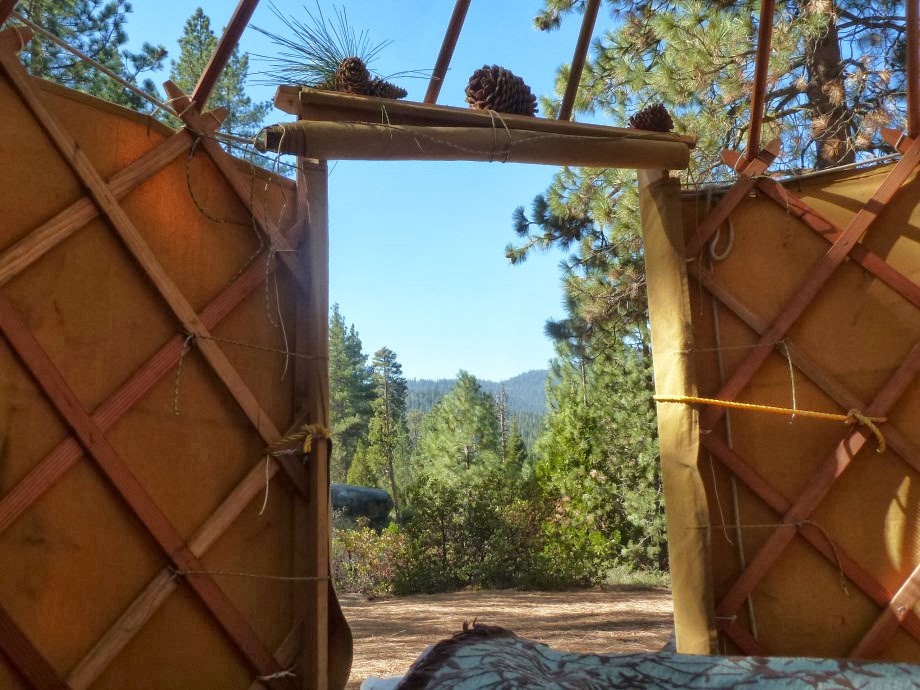
This shot was meant to show how small the yurt looks in a natural setting.  It looked much larger when I first set it up in the driveway of our house. We left the roof cover off so we could look at the stars at night.
Here is a picture of the yurt in the afternoon when the sun is hitting it.  We peeled back the wall for better air circulation.
Here is the yurt with the roof cover on.  We may still sew darts into the overhanging portion of the roof to take up the wrinkles.
After we got kicked out of Kings Canyon due to government shutdown, we found a camping spot in Sequoia National Forest right next to a Jeffrey pine.
Here is a longer shot of the yurt to show its size in proportion to the pines.
And then it snowed.  Clouds moved in in the morning and we put the roof cover on.  I had not yet made a smoke hole cover so a plastic tarp had to do the job.  The snow all melted once the sun came out.
A closeup on the tension band that holds the top of the wall in against the pressure of the roof poles.
And a closeup of the roof pole to wall junction.
The tarp leaked a little since laid flat over the smokehole ring to which I had not yet added any arch.  Here I have added some willow twigs to remedy that problem.
All in all, we were pretty happy with how the yurt behaved.  Next addition, some flooring to isolate the bedding from the ground and a small wood stove for heat.

Sunday, October 20, 2013

Camping as Space Travel


Camping is often lauded as a way for harried urbanites to re-connect with nature.  Well maybe. Decades ago, I used to go on canoe trips to Quetico Provincial Park in Ontario, Canada, sometimes with friends and sometimes with family.  To do these trips, we had to pack all the food we would need for the length of the trip.  Not packing enough food would mean going hungry since there are no stores in the park.  Then at some point, I took along a fishing rod and caught fish to supplement our meals and surprisingly, my experience of the camping trips changed.
The best way I could describe the new relationship was that it no longer felt like space travel where you had to bring absolutely everything with you that you needed to survive.  Once I was able to catch fish, my environment took care of some of my needs.  I was not entirely reliant on my environment to provide me with food, but I was not entirely reliant on what I had brought with me either.  I felt a new bond with my surroundings.  My surroundings now provided for me.  My presence in the wood and lake country was in a sense approved of by my environment.  I could say that I now filled an ecological niche, that of a fish eater.  I was no longer simply a tourist on a life line that led back to the civilized eco-niche that I had come from.
Yes, I was by no means living off the land simply because I caught a few fish, but the fact that the land I traveled through provided me with at least a part of my sustenance changed my relationship with it.
Camping in Kings Canyon, NP.  The yurt dwarfed by tall pines and the canyon wall.
Fast forward to the recent past.  My wife and I spent a few weeks camping in the Sierra Nevada mountains of California.  We started out at Kings Canyon National Park but were kicked out because of the government shutdown.  After expulsion, we moved on to the Sequoia National Forest where they allow dispersed camping, that is, camping somewhere other than at a designated National Forest campground.  We were now entirely on our own for amenities since the NFS wasn't providing any.  That is, other than a spot to park your car and pitch your tent, the forest service wasn't  providing anything, no toilets, no water, no garbage cans, no bear boxes, no pavement, no wood. Worse yet, because of a prolonged drought, we could not build fires either. We had to stick with our propane fired camp stove.  We were able to manage without toilets and had enough drinking water to get us through a few days at a time before needing to replenish.  But in a way, we were back in space travel mode.  Absolutely everything we needed to survive had to come out of our space module, the family car.
The yurt after our relocation to Sequoia National Forest. 
Not that camping in a  National Park was any better.  If anything, under normal conditions, it was even more restrictive and artificial an experience than camping in a national forest.  In a national park, you are not supposed to interact with the environment in any way.  You can't burn the wood, you can't pick the plants.  You can't hunt the animals, nor feed them, though apparently, you can do some fishing where there are fish.  Mind you, I am not criticizing National Park policy.  I am simply stating the effect it has on the experience of being there which is that it is not meant to be an environment that will support human life. It is an environment that tries very hard to minimize human impact. Any self sustaining activity other than fishing is in effect prohibited.  To return to the space travel metaphor, I don't know whether Star Trek with its prohibition of modifying alien cultures came up with this idea on its own or got it from the National Park Service, but there we were, camping without modifying the environment.  For the most part, it's great to be in a national park because they manage to preserve the landscape in a state that resembles the state it was in before Europeans showed up.  That is, besides some of the most stunning scenery, you also get to see what trees looked like before people cut them all the big ones down.  And unlike the national forest, nobody is using the national parks as cow pasture.
So far I haven't even mentioned backpacking.  Backpacking gets even closer to space travel than car camping.  For backpacking, at least the way it's done these days, you need all sorts of specialized gear that you can only get in a high end camping store.  Everything needs to be light weight, including your food which resembles the food of astronauts.
But you can still have some sort of camping experience that doesn't resemble space travel if you are willing to be creative and accept the fact that you can't have humans invading an environment without having some impact on it.

Monday, August 19, 2013

More Uses for a Two-ton Crane

My neighbor at the shop came up with yet another novel way to use the two ton overhead crane.


Ben floating over the bottom of his boat with his dad in the background steering the crane to move him into position for applying the next batch of resin.


Sunday, June 30, 2013

Plastic kayaks - Pros and Cons

Recently, a friend let me paddle his plastic kayak, a boat that he was quite fond of.  I never turn down an opportunity to try out other kayaks and so I got in this one and paddled away.  The boat looked very pretty with its white bottom and yellow top and was still new and shiny, but the bow seemed too blunt and pushed too much water, creating much noise in the process. It wasn't a flaw that you would be likely to notice just by looking at the boat, but it was readily apparent once you paddle it.
I reflected on this and came to the conclusion that I couldn't be the only person that noticed this problem with that boat.  But given that the manufacturer had already invested in a mold, he probably had to sell a certain number of boats before he could recover the cost of the mold.  Only after that point could he consider making a new mold.  The longer he held on to the old mold, the cheaper the cost per boat would be.
And that, in a nutshell is one of the major problem of mass produced boats.  The thing that makes mass produced boats cheap is that they involve a minimum of labor.  Make a mold, and once you have a mold, you can squirt plastic into it and out comes one shiny boat after another.  But the mass production is a good thing only if you have designed a good mold.  The manufacturer had better built a number of prototypes and tested them for good design before committing to a mold.
If users give the manufacturer feedback on design flaws, he really can't do much until his first mold is payed for. And this is more of an issue for small manufacturers who, lacking deep pockets need to pay as they go.
If you buy a custom boat from an experienced builder, you pay more than for a production boat, but you are also less likely to be a victim of design flaws.  I suspect the custom builder gets to build a lot more boats and gets a lot more design experience than the builder of production boats.  I might be wrong, of course, given that I don't really know what credentials production boat designers have or whether production boat manufacturers even have experienced designers on their teams or just hire consultants or copy someone else's designs.  If anyone knows, I'd like to hear from them.

Thursday, June 27, 2013

No More Spots


The dust motes, like floaters in your eye are most noticeable in the sky which is a uniform color.  They are not that noticeable elsewhere.  In a way, they are cool once you get over the notion that the sky should be a pure uninterrupted blue.  The floater are like nature's graffiti on your sky.
Over time, my camera accumulated dust in the path of the light between the outside of the lens and the sensor that translates that light into digital data.  And it never got better, just worse. This never used to be a problem with the old cameras.  But for some reason it is a problem with the digital cameras.  So I thought that the end of my digital camera was near.  But just for grins, I checked out the handy google find anything on the internet utility and lo and behold, there was a guy in Oakland who removed dust from your camera.
The way he told it, the dust is not in the lens but accumulates on the sensor that translates light to digital data. I'm not sure that that's the only place the dust was that he removed, but the net effect was that for $65, I was able to get a regulation blue sky without spots on it.  We'll see how long that lasts.

Wendy Tremayne and the Good Life Lab


I met Wendy Tremayne through my wife who participated in a Swap o Rama Rama event at the San Mateo Makers Faire.  The Swap o Rama Rama idea was Wendy's and the concept is based on the calculus of what it takes to live a Good Life.  Is it better to be a wage slave and live a crummy life so you can buy commodities with money or is it better to live the life you want and get your commodities by some other means.  Wendy and her partner Mikey did the math and concluded that it was better for them to live the life they wanted and get their commodities by means that involved as little money as possible.
So that's what the book is all about, the math on what it takes to have a decent life when you have a job and money but little time vs. having a decent life when you have no job and little money but all the time to do what you want. Plus, having done the math and concluding that you'd rather have a good life and little money, how to tap into the waste stream to get the commodities you need and developing skills to do stuff on your own that you used to pay other people to do when you had money but no time.
And having had some time to talk to Wendy, I also found out that she is one of those genuinely authentic human beings that radiate a goodness that outshines any ego that might still be clinging to their bodies.
Quitting your job to live the good life is obviously not for everyone, but if by some stroke of luck you get fired and can't find another job, you should maybe get this book and look at some alternatives.
For a more in depth review of the book you might also want to look here. The review also has an interview with Wendy.
Perhaps the best part of the Wendy approach to the good life is that is not a fixed prescription but rather a more general approach, that is, living off the waste stream of our culture is not a permanent solution, but rather a way to live right now while there is a large waste stream.  If that waste stream were to dry up, then some other way of living will be needed, but for now, it's a good way to go.

Just-In-Time Upcycling

In the old days, like back as far as the 60's people used to re-use stuff.  Then along came re-cycling which was not the same as re-use.  Re-cycling meant grinding stuff up and then using it as feed stock for something brand-new.  Old stuff was passe. New stuff was hip.  Recycling was something that hippies did.  Re-use was something your mom or your grandmother did. That is, your mom didn't throw away your old clothes but patched them up or made them last a while longer by maybe altering them or embroidering on them or turning old stuff into quilts, or your dad would take bent nails and pound on them with a hammer till they were straight again and could have another life. 
And then, stuff became so cheap that re-use became too quaint for any reasonable person to countenance.  Re-use became more expensive if you counted your time than simply throwing stuff away and buying new.  That was in the days when people had jobs.
But now that jobs are going extinct, more and more people don't have jobs and all of a sudden, re-use isn't such a stupid proposition.  But re-use isn't a cool name for what we are doing and instead it has been re-branded as up-cycling. Whatever. 
It is what it is and little by little, more and more people are tapping into the recycling and waste stream and extracting materials from it that once upon a time were practically worthless.  Instead of grinding everything down to pulp and then squirting it out of some machine to make new stuff, more and more people are taking the practically worthless stuff and using it as is or modifying it just a little to fit their own use.  Nothing new, really, but as more and more people do this, the stuff that used to be worthless will become more and more precious.  With nobody having jobs and the money to buy the new stuff made from old stuff, the old stuff as is without being recycled will become more expensive.
So this is where the concept of just-in-time upcycling comes in.  You have to grab stuff out of the waste stream and modify it to suit you while you can, before everyone else realizes that this is where it's at and makes the stuff that is now being thrown away into an expensive commodity.
Check out Wendy Tremayne and The Good Life in my next post for more on this topic.

Good News!! Tapping the Waste Stream

While the world economy as a whole might be circling the drain and every other country is having watercanon fights with its citizens, here in Alameda, we are making do with what we have, namely, leftover stuff from the times of plenty.  All this sort of thing is given catchy names like upcycling, diverting the waste stream, etc.  what it comes down to is that if you can't afford new stuff, you might want to use some old stuff instead.  And so the dog - woman boat featured a few posts back was made almost entirely out of old stuff, not as a stunt but out of necessity, the necessity being that when money is scarce, you make do by other means.
The builder, Inka had access to various pieces of cast off wood from her building jobs and the skin of the boat was made of scraps that I had left from other boat projects that Inka then sewed together on a friend's sewing maching.  For the coaming rims, we scavenged some branches from weed trees in the neighborhood and when it was all done, we had a boat that for the most part wasn't that much different from a boat that we would have built had we used all new materials. 
Skin of sewn-together pieces from other projects, giving the boat a traditional look, although from a distance, you can hardly see the seams.
And that in a nutshell is what boat building in the Arctic was like in the old days.  You had to scrounge all the stuff you made your boats out of.  Takes a little more time than buying everything fresh at the boat supply store, but worth it, especially when you have more time than money.
So if you have more time than money, contact me and I will tell you how to make a boat from found materials.

Moving Boats


Jan Adkins wrote a book called Moving Heavy Things.  The other day I decided to use the two ton crane at the shop to lift a kayak up into storage.  A bit of overkill for a 40 pound boat, but what the heck. The thing was unwieldy and sometimes a crane is just the thing to use, assuming of course that you have one.


Hook it up,

and hoist it.
And of course, sometimes your boat is actually big enough to require a crane, this time, the Italian Americas Cup boat, Prada going from the concrete apron into Alameda's seaplane lagoon.

Hot Air Wood Bending

NOTE to readers:
This particular post has gotten the most traffic of all my posts for a while now.  Is there really that much interest in wood bending?  I would remove it if I thought that this post draws readers to my page by mistake, but then again, I'm willing to leave it up with the hope that would-be wood benders might also be interested in kayak building.  So other than that this page skews the statistics for this blog, no real harm done.  Hot air wood bending, really? Who would have known.

Steam bending of long pieces of wood requires a long steam box and a lot of time to get the steam box heated up.  So unless you intend to steam a lot of pieces, waiting for the box to heat is a pain.  Instead, we did some hot air bending.  The wood, black acacia had soaked to the point of sinking and so was thoroughly saturated with water.  So with a hot air gun and lots of clamps, we heated a few inches of wood at a time, bent, clamped and then moved on.  Simplicity itself.
Heat the inside.


Heat the outside, bend and clamp.
All done.  Wait for the thing to dry, remove clamps and glue.

Woman - Dog Boat

Inka Petersen launched her two hatch baidarka yesterday.  One hatch was for her, the other for her dog, Rosie.  The boat was a bit of a challenge to design since its volume was fairly small - total length 15 feet by 22 inches wide.  With low free board, proper trim becomes more important.  So we launched the boat.  I will let the pictures tell the story.
The boat empty. Trim good.

The boat minus Rosie.  Needs ballast.

The boat with Rosie in the dog seat. Trim pretty good.
Actually, part of what contributed to the trim inequity was that none of the seams had been sealed yet and the boat was taking on water fast and heading for the stern.  Still, we all were happy, christened the boat with some Anchor Steam, a local SF brew.  I was hoping for some Alaskan Amber but the supermarket wasn't handling it. Plus I got a swim in. 

Sunday, June 2, 2013

Fiberglass and other crimes

Sometime ago I got the notion that when you build something yourself you get to control how much violence you do to your environment and to yourself.  Your time is your own and you know how to price it when you're doing something for yourself and so you can make good decisions rather than the strictly economic decisions of someone who has no goal other than to make money.
If you buy something that's been manufactured disreputably, the seller usually takes great care to keep you ignorant of how much damage was done to the environment and the people who manufactured the thing. The seller usually tries to create a happy shopping environment that floods your brain with endorphins so that you forget all about the awful conditions under which the thing was made, assuming that you ever cared how the thing was made or were able to find out how it was made if you did. Or as someone once said about sausages, you don't really want to know what went into them. And so if you buy anything you probably don't want to know how it was made.

So when somebody actually says something honest about a manufacturing process, I am heartened, and so I quote here from Thomas Firth Jones excellent book, Low Resistance Boats.
"Fiberglass work is alienating, because no matter what suits are worn and fans are run, it's smelly and filthy and unhealthy.  It's possible to lay up a hull or two nonchalantly, but if the work is done steadily, alienation sets in. I've never known a conscientious fiberglass worker, and when opportunity arises, many will go beyond carelessness to sabotage.  Urinating into the mold is standard.  Beer bottles and pails of uncatalyzed resin are routinely chucked into keels.  Whenever possible, the work is done drunk."
Well, you get the idea.  Jones goes on to advise the prospective buyer of a fiberglass boat to get it from a shop that doesn't do enough fiberglass work to be alienated by the process.

Saturday, June 1, 2013

Stegosaurus Boat Construction

Ben, my neighbor at the shop is building a motor boat. The process of boat building is a great deal easier than it used to be due to CAD files and NC routers. The long and the short of it is that you no longer need drawings from which to build a boat.  The shape of the boat parts is contained in a file that can be downloaded to a numerically controlled (NC) router that cuts not only the molds but also the frames and bulkheads that make up the boat.  Once all the molds are routed out, they are assembled in a manner that resembles one of these stegosaurus models they sell in museum gift shops.

 Once you have all the molds and frames assembled, you are ready to glue the permanent components together.  After that, you cover the whole thing in plywood and then in fiberglass and epoxy resin and you have yourself a boat.  No lofting and other traditional unpleasantness.
The view from the rear.  Note the cramped quarters.  Luckily, Ben has all of his machinery on wheels so he can roll it out of the way or into position as need be.

Three quarters view from the rear.  The plywood stays in the boat and the stuff without grain is temporary molds and gets removed.

The view from the front of the stegosaurus.


San Francisco Maritime Museum Warehouse Relocation

For some time, the San Francisco Maritime Museum housed various odds and ends in a warehouse at the former Alameda Naval Air Station.  A few weeks ago they apparently relocated to a warehouse in San Leandro.  So for a few hours, various of their treasures, mostly unrestored wrecks or parts of wrecks were staged on flat bed trucks outside the Alameda warehouse that I fortuitously happened to pass on the day of the move which allowed me to take some pictures which I now am able to share.
A wooden boat and to the left of it, who knows what, maybe a boiler off a steam ship.
parts of grown crooks off something picked off a mud flat somewhere in SF Bay.

An iron hulled boat to the back in red and black and something smaller in white and blue and wood.

some more detail on the wooden boat.

And the stern of the iron boat.  Very graceful.

And the iron boat close up. Looks like rust never sleeps.

A chunk of cross section of a wooden ship.  A wooden frame and six inch thick planking.  Looks kind of like a rack of ribs.

I have no idea what this is. But it looks like metal.

And more of the same. Could be the obelisk from 2001 Space Odyssey.

Some of the planking fell off revealing the steam bent frames.

I have no idea what it is. but it no doubt housed gentlemen at sea at one time.


Saturday, May 11, 2013

Goose Story


The geese are starting to hatch out back of the shop. A few days ago while riding my bicyle home, I ran into this family of geese, mother, father and eight goslings on the other side of a cyclone fence that keeps people away from the water.  I stopped, intending to take a picture of the happy family but realized that I had forgotten my camera. I had to settle for just looking at them.  As I got closer to them, the father got into his protective role, lowered his head and hissed at me.  And then I noticed, off to the left, at a safe distance from the protective father, a crow, watching for straggler goslings and the chance of a meal. 
Coincidentally, three crows had showed up at the shop just a few weeks earlier, no doubt just in time to take advantage of the impending gosling season.
A few more days went by and a visiting friend told me of a crow with a broken wing that he had seen on the way in to the shop.  Ah, crow with a broken wing.  No doubt some unfortunate accident, but then it occurred to me that the crow might have gotten a little too bold and run afoul (afowl) of the father goose who had possibly broken his wing.  We can't know for sure, but for sure I got some pictures two days ago of all eight goslings still waddling and swimming about with their protective parents flanking them.

Saturday, May 4, 2013

Bent Shaft Paddles

I've been making a number of prototype paddles at the request of a friend and promoter of my paddles.  After a number of weeks I came up with two winners.  One is a bent shaft Greenland style paddle.  The other is an Aleut style paddle with some amount of extra bend added to it.
There were some other paddles in the mix that weren't winners but they were instrumental in helping me figure out the specifics of what made the winning models work. I have made Greenland style bent shaft paddles before and quite by luck come up with the right design, but this time, I did some deviation from the winning model only to find that the original was still the best. The Greenland style bent shaft may actually have originated in East Greenland as reported by John Brand who found some examples of these paddles in museums and originally thought that they were just straight paddles that had warped over time, but after some reflection decided that they were actually made that way on purpose.
The bent shaft Aleut paddle is not completely new.  I had made two of these before for a friend but never actually paddled them myself.  This time around I did use the bent shaft Aleut paddle and found it to be a useful variation on the standard version that I usually make.
Four paddles out for a test run. From left to right, a Greenland breakdown for a customer, an Aleut with some bend in the direction of the ridged face, a Greenland style with significant bend and another Greenland style with moderate bend.
One of the key aspects of a Greenland paddle is that it is highly symmetrical, that is, no matter how you hold it, its performance is the same.  The Aleut paddle by contrast has a lower degree of symmetry. You can switch right and left blades without changing performance but you cannot change ridged face for flat face without changing performance.  The reason is that in one configuration, the face of the paddle trails the axis of the loom while in the other, it leads the axis of the loom.  Although the amount of offset is small, it nevertheless makes a difference in the way you need to move the paddle through the water to get it to work.
The same is true of the bent shaft Greenland paddle.  The slight amount of offset of the blade has it either leading or trailing the axis of the loom depending on how you hold it.
My insight while doing the testing on the bent shaft paddles was that when you pull a paddle through the water, you move it through an arc during which the angle the blade makes with the water changes.  The efficiency of the paddle is at its greatest when the blade is perpendicular to the surface of the water. As the stroke progresses, the angle the blade makes with the water changes from the vertical and the amount of force you exert that translates into forward motion decreases.  At the same time, the boat is accelerating forward and the water is accelerating backward so that as the stroke progresses it becomes less efficient.  So having the shaft bent to make the blade more vertical at entry into the water improves its efficiency.
On the other hand, when the paddle is used in a low angle cruising position, that is, with the loom held low and close to the deck then the paddle held so that the blade trails the loom makes the blade self orienting and requires less of a tight grip to keep it properly oriented.  While this stroke generates less thrust than the high angle stroke, it is more efficient at lower cruising speed and less tiring in headwind conditions or against the current conditions.
Whether my understanding of the mechanics of these paddles is correct or not, the fact is that they work in practice as confirmed by speed trials with a GPS.

Sunday, April 28, 2013

l'hydroptere in Alameda

The French boat l'hydroptere is currently in Alameda being overhauled at Nelson Marine before heading to LA where the team will try to beat the world record time for the LA to Honolulu trip.  Apparently, the boat did over 45 knots in San Francisco Bay. If this sort of thing interests you, you can find full details at the l'hydroptere website.
If you go to the website, note that everyone is wearing wetsuits.  Because these boats are fast they make for lots of spray.  Sailing these boats is apparently more of an athletic event than a pleasure ride.
Here it is. The boat has a main hull and two outriggers.  The foils extend down from the outriggers.

A closeup of one of the foils, folded up from the outrigger.

And another view of one of the outriggers detached from the wing.  You can also see the steering wheel of which there are two, one on each wing.

Five Gyres and More


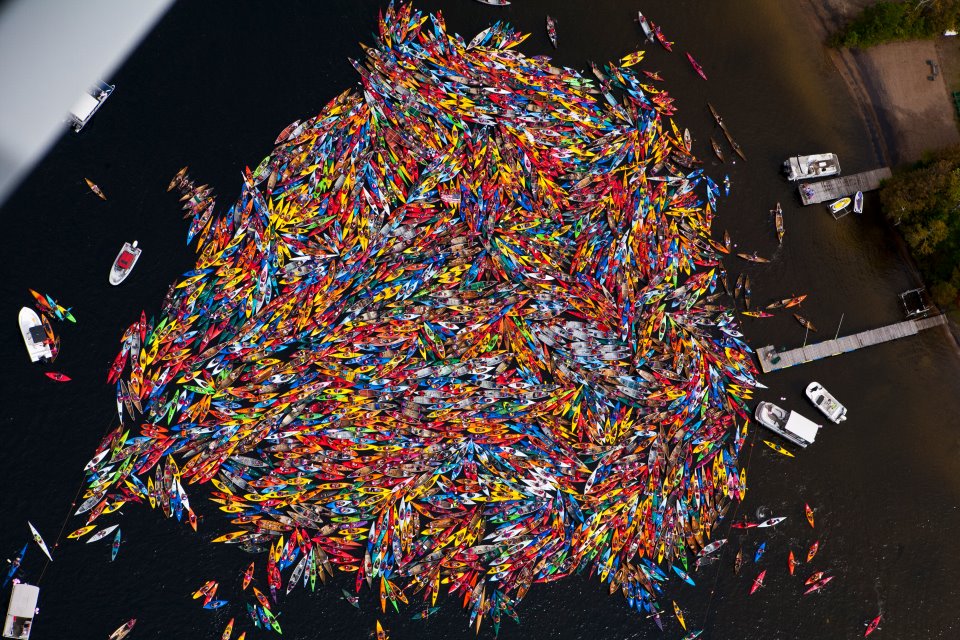
 I saw this photo of kayakers on facebook and the thing that popped into my head unbidden was, Plastic Gyre.  Of course this isn't a plastic gyre, the real plasic gyres are in the world's oceans and there are five of them and they are huge, and while there may be some plastic kayaks or kayak parts in these gyres, the majority of the plastic is from other sources.  So whenever kayakers decry plastic pollution, I see some irony in their stance.
I posted this picture before under the heading, how many kayaks are there? and this massive assembly of kayaks really does come close to being a genuine plastic gyre. And before you accuse me of being holier than thou with my wood frame skin on frame kayaks, I confess that yes,  there are plastic resins used in its construction, mostly in the skin and the lashings and the coatings used to seal the skin.  And I also wear some plastic garments when paddling and the small fibers that they're composed of break off during washing and end up in the ocean where they displace plankton in the bodies of animals that eat plankton.
Let's let the issue of whether I am a hypocrite or not rest for a moment and look at the obvious problem of plastic pollution in the world's oceans.  The organization Five Gyres has devoted itself to the problem. Click on THIS LINK to find out more about them.
Policy director Stiv Wilson of Five Gyres explains in an ARTICLE that plastic pollution on the world's beaches is not the main problem but could be a big part of the solution. While the five gyres collect plastic that has made it into the oceans, they also spit out a certain percentage of plastic each year.  Some of the plastic moves on to different gyres, but some of it also gets spit out and ends up on beaches.
If we were to stop making plastics tomorrow, and did annual beach cleanups, plastic would be gone from the world's oceans in a matter of decades.
The problem with the plastic in the oceans is not that the plastic ends up on our beaches and assaults our esthetics but rather that when in the ocean it harms the animals that live there. Inundating the world in plastic products and then expecting none of them to end up in the oceans is not realistic.  Maybe stopping the production of plastic is not realistic either but it sure would fix the problem.  What we have to decide is whether not having plastics in our lives is a bigger inconvenience than having it in our oceans. We've lived without plastics before and we can do it again.